UK Government Has Made AI Training Mandatory. Your Organisation Can Do The Same.
AI is no longer a side project inside UK government. It is being treated as a core skill, on the same level as data and digital. HMRC and the wider Civil Service are now doing, at scale, what many private organisations are still only talking about.
The interesting bit though is how closely that direction matches what we are already doing at Techosaurus.
HMRC: No Training, No Licence, At Real Scale
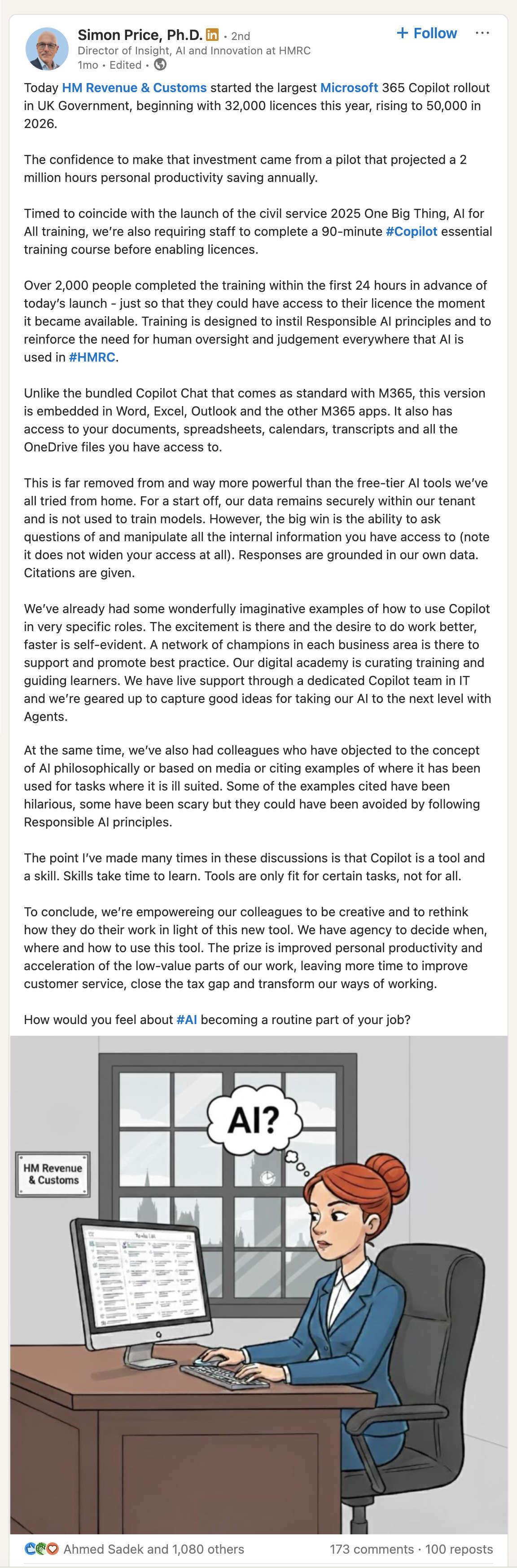
HM Revenue & Customs has started the largest Microsoft 365 Copilot rollout in UK government:
- 32,000 licences this year
- Rising to 50,000 by 2026
They backed that decision with evidence. A pilot projected around 2 million hours of personal productivity saved every year, which gave them the confidence to invest.
Crucially, this is not the free web chat people play with at home. HMRC’s Copilot is:
- Embedded in Word, Excel, Outlook and other M365 apps
- Grounded in internal email, documents, transcripts and files
- Running securely inside HMRC’s own tenant, with data staying in-house
And they have set a very clear condition:
No training, no licence.
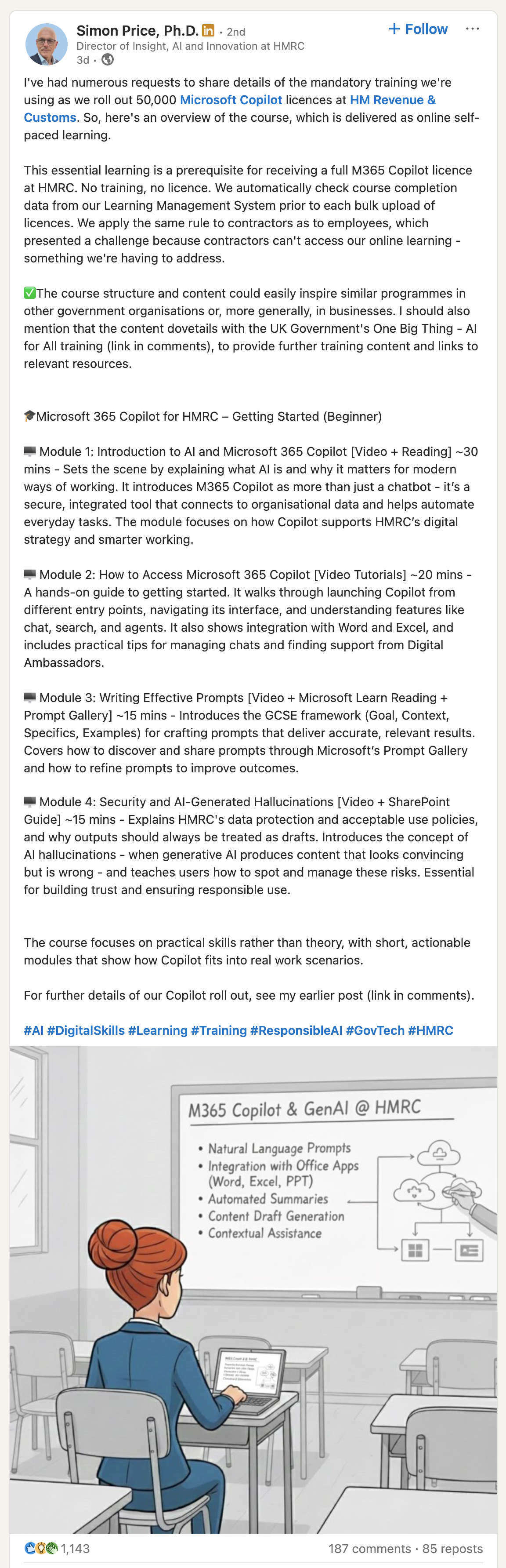
To get access, every member of staff must complete a 90 minute Copilot essentials course. That training:
- Introduces AI and Copilot in the context of HMRC’s work
- Teaches a simple prompting framework
- Covers security, hallucinations and responsible use
- Reinforces that Copilot is a tool and a skill, not a magic replacement for people
They are supporting this with:
- A network of local champions in each business area
- A digital academy curating training and good practice
- A dedicated Copilot support team in IT
- A clear intention to move next into agents and workflow automation
So HMRC is not just “letting people play with AI”. They are managing adoption as a skills and culture shift.
One Big Thing 2025: AI For All
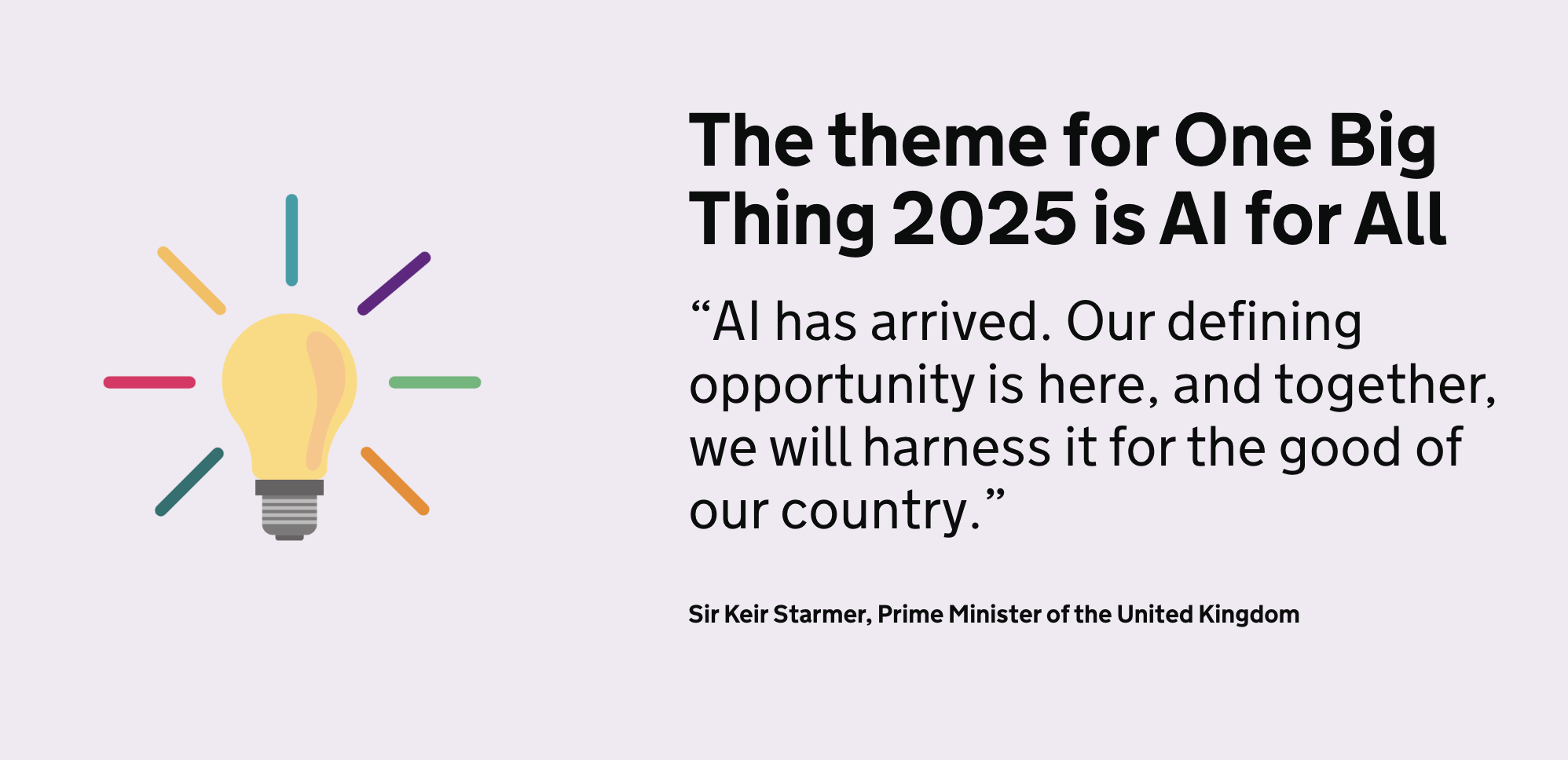
Around that, the UK government has launched One Big Thing 2025: AI for All.
One Big Thing is the Civil Service’s annual, cross-government upskilling campaign. Previous years focused on innovation and data. For 2025, the priority is explicitly AI.
From October 2025 to February 2026, every civil servant is expected to:
- Learn AI essentials through tailored e-learning or departmental programmes
- Use AI in the context of their real work, not just as theory
- Take part in department-led activities to explore opportunities and risks
There is also a dedicated pathway for senior leaders so they can steer AI adoption confidently, not delegate it blindly.
The message is very clear though:
- AI literacy is now part of the core skillset of a modern public servant
- AI is a lever to free time, improve services and focus people on work only humans can do
- This is the start of a longer journey, not a one-off campaign
When the Prime Minister and the Government Chief Digital Officer are both talking about “AI for All” and “building a Civil Service fit for the future”, it shows where the bar is moving for everyone else.
Why This Matters For Private Organisations
Once central government is:
- Rolling out tens of thousands of Copilot licences
- Making AI training mandatory before access
- Publishing case studies on productivity, accessibility and risk
Then “we will get round to AI training later” quickly stops being a safe position.
Your people will compare their experience to what friends and partners in government are getting. Regulators and clients will expect you to take risks like hallucinations, bias and data protection just as seriously. Future tenders and partnerships will quietly assume a basic level of AI literacy across your teams.
The good news though is that you do not have to reinvent any of this from scratch.
Techosaurus already has a learning ladder that mirrors the structure government is putting in place.
How The Techosaurus Ladder Maps To The Government Approach
Here is how our offer lines up with what HMRC and One Big Thing are doing.
1. Generative AI Skills Bootcamp 1.0
60 hours over 10 weeks, in person, government funded
Our multi award winning, in-person Bootcamp with Yeovil College gives people deep, practical AI capability, very similar in spirit to the Civil Service’s “AI for All”, but with a stronger focus on real business workflows. Learners:
- Understand how large language models work under the bonnet
- Build prompts and workflows for their actual role
- Create business process maps and AI adoption plans
- Leave with a concrete transformation roadmap for their organisation :contentReference
2. Generative AI: Automate and Build More 2.0
60 hours over 10 weeks, in person, government funded
This is the follow-on programme, focused on automation, integration and intelligent systems. It is where many organisations want to head once basic AI literacy is in place:
- Automation with tools like Power Automate, Zapier and n8n
- Building AI-enabled workflows that connect systems together
- Understanding where AI is the “brain” and automation is the “hands”
- Designing and demoing real, AI-enabled processes
It aligns closely with HMRC’s direction of travel towards agents and deeper workflow transformation.
3. Practical AI Online: 20 Hours of Certified CPD
Online, self-paced, accessible anywhere
This is your working-level layer. Our Practical AI course provides over 20 Hours of Certified CPD, 50+ hands-on tasks and a tool-agnostic approach that works with ChatGPT, Claude, Copilot or Gemini.
Pricing is straightforward:
- £199 for individuals
- £125 per learner for the first 10 business licences
- £99 per learner for any licences after 10
This sits in the same space as the Civil Service’s “AI for All” learning, but designed for private sector constraints and use cases.
4. Coming Soon: AI Light, Your AI Essentials Layer
The missing piece has been a simple, structured entry point that feels like HMRC’s Copilot essentials course, but tailored to private sector teams.
That is what AI Light is for.
Inside AI Light: A 7 Part AI Essentials Series
AI Light is designed as your “no training, no licence” foundation. It gives everyone in your organisation a shared baseline before they start using AI for live work.
Here is what each video covers.
Session 1: What AI Really Is
A clear, myth‑busting introduction to AI that:
- Explains AI in plain language, without the hype
- Shows how we moved from traditional search to conversational AI
- Frames AI as a human soft skill, not just a technical topic
The aim is confidence. People should finish this session feeling that AI is something they can use, not something being done to them.
Session 2: How AI Thinks
This session opens the black box just enough to be useful:
- How neural networks work at a high level
- Why models predict one word at a time
- Why two people asking the same question can get different answers
With that mental model, your teams can better understand both the power and the limits of tools like ChatGPT and Copilot, and are less likely to be surprised when outputs go wrong.
Session 3: The Three Golden Rules
Here we introduce three simple principles for safe, effective use, including:
- Letting AI take you most of the way, but not all the way
- Always treating outputs as drafts, not final answers
- How to fact check, cross reference and validate
This gives staff a practical checklist they can hold onto, so they stay in control of the work rather than handing judgement over to the tool.
Session 4: Everyday Uses Of AI
This is where people see what AI can actually do for them day to day, such as:
- Summarising documents and meetings
- Drafting and rewriting emails
- Generating ideas, plans and outlines
- Learning complex topics more quickly
The focus is on realistic, repeatable examples that can boost productivity immediately, not shiny gimmicks.
Session 5: The ROAR Prompting Framework
Here we introduce ROAR: Role, Objective, Appearance, Restrictions.
Learners see how to:
- Set a clear role for the AI
- State what “good” looks like
- Define the format or appearance of the output
- Add constraints like audience, length or tone
We show before-and-after examples so people can feel how a better prompt leads to far better results.
Session 6: Practical Prompting Techniques
Building on ROAR, this video covers the techniques that power users rely on, including:
- Chunking, for long or complex documents
- Few-shot prompting, using examples to steer style
- Iteration and refinement, rather than one-shot requests
- Simple chain-of-thought approaches
- The “reverse interview” method to surface blind spots
The goal is to turn AI into a collaborative partner, not a vending machine.
Session 7: Risks, Errors And Staying Safe
The series closes with a balanced view of risk that covers:
- Why AI hallucinates and how to spot it
- How training data and bias affect outputs
- The impact of ambiguity and knowledge cut-offs
- Practical rules for handling sensitive information
- Choosing the right platform for your work
By the end, people understand why AI can be wrong, what to watch for and how to use it responsibly inside your organisation.
Turning AI Light Into Your Own “No Training, No Licence” Policy
Once AI Light is live, you can mirror HMRC’s approach in a way that fits your context.
For example, you could:
-
Define the tools and scope
Decide which AI tools you support officially (for example Copilot, ChatGPT Enterprise, an internal assistant). -
Set AI Light as the baseline Require staff to complete the 7 part series and short quizzes before they use AI on live client or internal work.
-
Make it part of your policy
Add a simple line to your digital or information security policy: “Completion of AI Essentials is required before using AI tools for work.” -
Nominate AI champions
Identify people who complete AI Light and the 20 Hours of Certified CPD and want to go further. Move them into the Bootcamp or Automation 2.0 and position them as local champions. -
Feed learning back into your workflows Use what you learn to update templates, playbooks and checklists so AI becomes part of how your organisation works, not a side hobby.
You end up with a learning and adoption ladder that looks very similar to government’s, but tuned for private sector reality:
-
Level 1: AI Essentials (AI Light)
Baseline literacy for everyone. -
Level 2: AI Practitioner (20 Hours of Certified CPD)
Working-level skills for people who use AI regularly in their role. -
Level 3: AI Champions (Bootcamp 1.0 and Automation 2.0)
Deep capability for those leading AI and automation in the business.
Where This Leaves You
If HMRC can require AI training before 50,000 people get Copilot, and if the Civil Service can commit to “AI for All”, it is hard to argue that private organisations should treat AI as an optional extra.
The question is less “Should AI become a routine part of our jobs?” and more “How do we make sure our people are ready when it does?”
AI Light, our 20 Hours of Certified CPD online course, and our government funded Skills Bootcamps give you a practical way to answer that.
Take The Next Step
If you would like to give your teams an “AI for All” pathway without building everything from scratch:
- Check out our courses here: https://tsrs.education/ai
- Or get in touch to register your interest in the new AI Light package
We can help you map a simple, realistic learning journey that fits your people, your tools and your reality.