Betwixtmas or not, the AI war does not stop, and here comes Meta with best friend Manus!
Yes, it’s Betwixtmas.
Yes, it’s meant to be a time for celebration, family, food, and at least one day where nobody knows what day of the week it is.
But while much of the tech world is still half-asleep on the sofa, trousers unbuttoned after too much turkey, the AI arms race has very much not paused.
And Meta has just pulled a move that deserves attention.
While the conversation over the last year has largely been dominated by ChatGPT, Claude, Gemini, Copilot and more recently Grok, Meta has quietly stepped in with a decisive acquisition that could materially shift the balance.
Meta has acquired Manus.
Official announcements:
- Manus: Manus Joins Meta for Next Era of Innovation
- Meta (Facebook Business News): Manus Joins Meta: Accelerating AI Innovation for Businesses
What Meta has actually done
Meta has confirmed that Manus is joining Meta, and importantly, this is not a vague partnership or experimental collaboration. This is an acquisition.
Manus will continue to operate as a product, continue selling subscriptions, and continue serving existing users, while simultaneously being integrated into Meta’s consumer and business products, including Meta AI.
This matters because Meta has not bought a model.
They have bought an execution layer.
Manus is not another conversational assistant. It is a fully agentic system designed to plan, act, verify, and complete real work end to end.
In simple terms, Meta has acquired something that does things, not just talks about them.
What Manus brings to the table
Manus already has a surprisingly broad and mature capability set, especially for a company that only launched publicly earlier this year.
Key capabilities include:
Autonomous agent execution
Manus is designed to independently complete complex, multi-step tasks such as research, analysis, coding, and content creation without constant human intervention.
This is not prompt-response AI. It is plan-execute-validate AI.
Web app design and hosting
Manus can design, build, and host simple web applications. That includes handling structure, logic, and deployment, not just generating code snippets.
For Meta, that capability maps neatly to business tooling, internal tools, and rapid experimentation.
Slides and presentations
Manus can generate structured presentations with narrative flow, visuals, and supporting material, not just bullet-point output.
This aligns directly with business users, educators, and internal teams.
Agentic browser operator
Manus includes a browser-level agent that can navigate websites, fill in forms, extract data, and complete web-based tasks.
This is one of the most powerful and dangerous capabilities in AI right now when done badly, and one of the most valuable when done well.
Multi-user AI chatbot
Manus already supports collaborative, multi-user environments, allowing teams to work with the same agent, share context, and coordinate tasks.
That fits cleanly into Meta’s collaboration and messaging surfaces.
Email and Slack integrations
Native plugins for email and Slack allow Manus to operate where work already happens, rather than forcing users into yet another AI interface.
Again, this is about execution inside workflows, not novelty.
Why this gives Meta a serious advantage
Meta already has scale, infrastructure, distribution, and data. What it has lacked until now is a production-ready, general-purpose agent that can reliably carry work from intent to completion.
Manus fills that gap.
This acquisition gives Meta:
- An agent runtime that already works
- A product with real users and real revenue
- A team experienced in building agent systems, not just models
- A shortcut past years of internal development
Crucially, it positions Meta as the first major player to combine frontier models, global distribution, and agentic execution at scale.
That combination should make every other major AI vendor uncomfortable.
A potential disruptor moment
This could be the moment where the current AI leaderboard gets scrambled.
Up until now, most competition has been framed around:
- model benchmarks
- reasoning scores
- token pricing
- context windows
Manus shifts the focus to something far more practical:
Who can actually get work done, safely, at scale, inside real business environments?
If Meta integrates Manus effectively across WhatsApp Business, Meta AI, advertising tools, and internal business platforms, this is no longer just a chatbot race.
It becomes a workflow ownership race.
And that is far more disruptive.
The security story has changed too
One of the historic concerns around Manus was trust.
It is a Chinese-founded startup, which later moved its operations to Singapore, and until very recently it did not present itself as enterprise-ready from a governance or compliance perspective.
That has now changed.
Manus has launched a Trust Centre showing:
- SOC 2 Type 1 compliance
- SOC 2 Type 2 compliance
- ISO 27001 certification
- ISO 27701 certification
- GDPR alignment
👉 Trust Centre: https://trust.manus.im/
SOC 2 Type 2 is particularly important. It indicates not just that controls exist, but that they have operated effectively over time.
Combined with Meta’s own governance, legal, and compliance machinery, this significantly lowers the barrier for enterprise and regulated-sector adoption.
This is not a cosmetic update. It is a signal that Manus is being prepared for serious, scaled deployment.
Our experience with Manus
We’re big fans of Manus and actively use it for non-sensitive work, particularly when we need to:
- mock up a quick website or app
- build a proof of concept
- rapidly visualise an idea before committing development time
If you want to see a genuinely impressive real-world example, take a look at our podcast website:

👉 Prompt Fiction Podcast: https://prompt-fiction.show
That site was built and launched by developers using Manus in under an hour.
This is exactly where agentic AI shines: speed, execution, and reducing friction between idea and reality.
So where does this leave us?
While the rest of the AI world was taking a festive pause, Meta quietly armed itself.
To borrow from one of my favourite Christmas films, Die Hard:
In this scenario, Meta is John McClane.
And now, as the saying goes…
Ho ho ho. Now they have a machine gun.
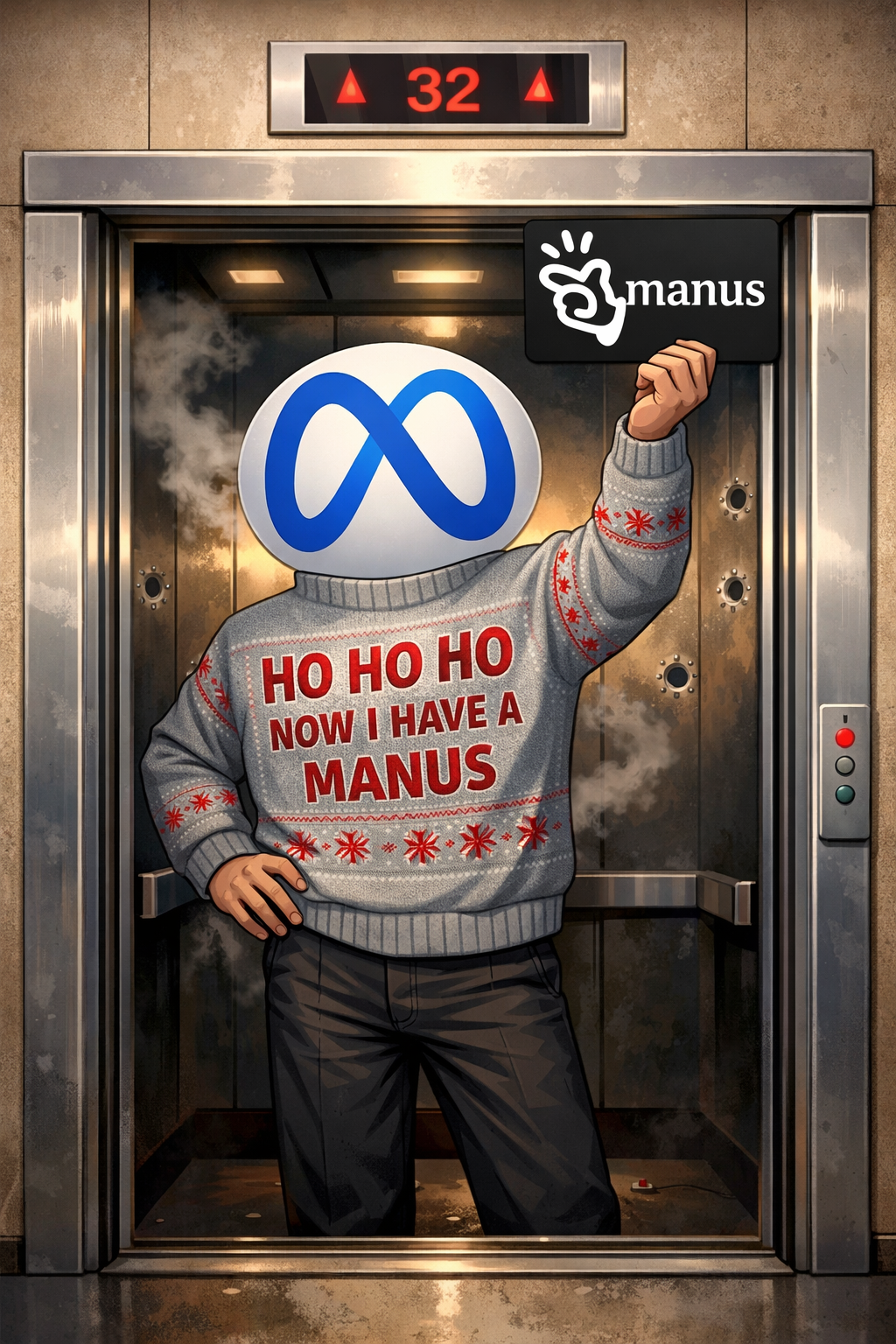
The AI war has just escalated, and 2026 could look very different because of this.
Want to try Manus yourself?
If you’re new to Manus and want to explore it hands-on, this link includes 500 free credits:
👉 Try Manus here: https://tsrs.uk/manus