Government Standards Catch Up to What We've Been Teaching Since Autumn 2024: Why Techosaurus’ AI Bootcamp Was Ahead of the Curve
The Department for Education just published safety standards for AI in education. We’ve been delivering them for over a year.
Earlier this week, the Department for Education published something that made me smile: their new Generative AI Product Safety Standards for educational settings.
Not because I love government guidance documents (I don’t), but because reading through the 13 standards felt like someone had been quietly observing our Generative AI Skills Bootcamp since autumn 2024 and decided to write down what we’d already been doing.
The timing is interesting. We launched our bootcamp in autumn 2024. The government published their standards in January 2026. That’s not us patting ourselves on the back - it’s validation that the methodology we built through trial, error, and real-world delivery actually works. We weren’t following a published best practice playbook. We were building one through delivery.
And now that approach is reflected in national guidance.
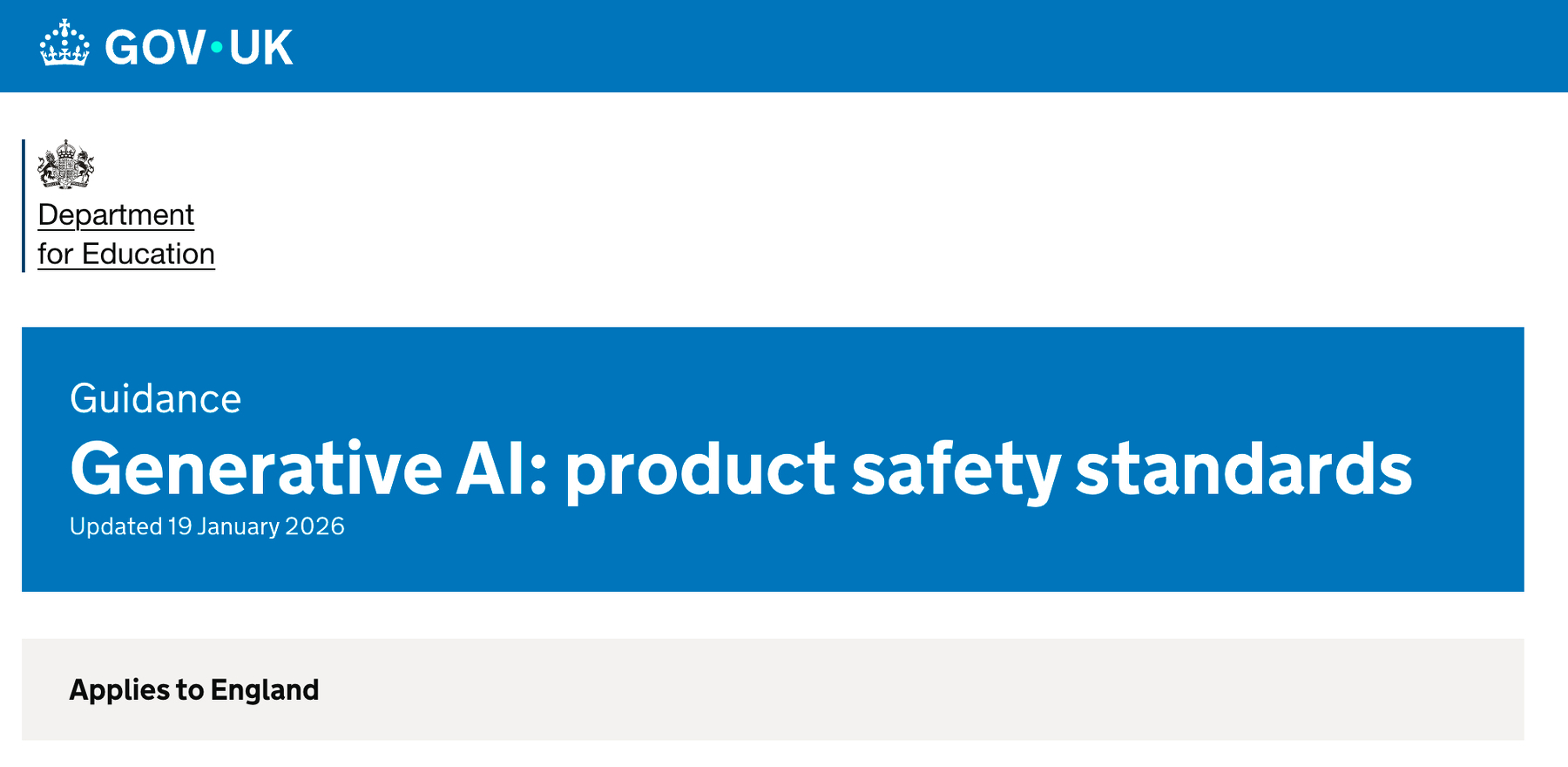
What the DfE Standards Actually Say (and Why It Matters)
The guidance is aimed at EdTech developers and schools procuring AI tools. It covers 13 areas, but three jump out as particularly relevant to how AI should be taught and used:
Cognitive Development Protection
AI tools must avoid “cognitive deskilling.” That means no providing complete answers by default. Instead, products should use “progressive disclosure” - hints first, then gradual detail, requiring student input before giving solutions. The goal is to prevent students offloading their thinking to the AI and actually bypassing the learning process.
Sound familiar? That’s literally our teaching methodology. We don’t teach people to copy-paste outputs. We teach them to prompt, iterate, verify, and refine. AI as delegation and augmentation, not replacement.
Emotional and Social Development
The guidance explicitly warns against anthropomorphising AI or creating tools that imply emotions, consciousness, or personhood. It also requires products to remind users that “AI cannot replace real human relationships” and includes hard time limits to prevent emotional dependence.
This one hit home, because we’ve always delivered face-to-face for exactly this reason. You cannot build healthy AI habits in isolation. You need real human discussion, pushback, reflection, and the messy conversations that happen when someone asks “Is using AI cheating?” or “What if this makes me redundant?”
Those questions don’t get answered well on a forum, or from behind a screen littered with distractions. They get answered in a room, with people who trust each other enough to be honest.
Responsible and Ethical Use
From Week 1, the guidance requires coverage of ethics, bias, security, privacy, and data protection. AI should be introduced with guardrails, not as a magic wand.
Our bootcamp starts with exactly that. Week 1: ethics, bias, and foundational understanding before anyone touches a prompt. Because if you don’t address the risks early, people either over-trust the outputs or panic about them. Neither is useful.
Why This Validates More Than Just Our Bootcamp
Here’s what makes this particularly satisfying: the DfE standards don’t just validate our Generative AI Skills Bootcamp. They validate our entire three-tier approach to AI training.
We’ve been running:
- An online course (Practical AI) for accessibility and awareness
- The Generative AI Skills Bootcamp for foundational skills, responsible use, and real-world application (since autumn 2024, 150+ businesses trained)
- The Automation Skills Bootcamp (brand new for 2026) for implementation, integration, and scaling AI into workflows
The government essentially confirmed that staged learning works. You can’t throw people into automation without first teaching them how to use AI safely and effectively. And you can’t teach AI well without addressing the human skills that underpin it: communication, critical thinking, delegation, and ethics.
It’s not a tech stack. It’s a capability ladder.
What We’ve Been Doing That the Government Now Requires
Let’s get specific. Here’s how our bootcamp maps directly to the DfE standards, often in ways we built instinctively before the regulations existed:
Week 1: Ethics, Bias, and Foundations
DfE Standard: Responsible and Ethical Use ✓
We don’t wait until Week 5 to talk about bias. It’s front and centre, day one. Because once someone starts using AI without understanding its limitations, the habits stick.
Week 4: ROAR Framework and Prompt Engineering
DfE Standard: Cognitive Development Protection ✓
Our ROAR Framework (Role, Objective, Appearance, Restrictions) is structured communication. It’s the opposite of “give me the answer.” It’s “help me think through this problem step by step.” That’s progressive disclosure in practice.
Week 5: British Values Research Activity
DfE Standard: Educational Use Cases ✓
We don’t just teach AI in a vacuum. We use it to explore real educational contexts, including research on British Values in Education. The tool is a means to an end, not the end itself.
Week 8: Business Process Mapping and AI Integration
DfE Standard: Design and Testing ✓
Before automating anything, learners map the process, identify where AI adds value, and design human-in-the-loop checkpoints. That’s systems thinking, not “AI go brrr.”
Face-to-Face Delivery Model
DfE Standard: Emotional and Social Development ✓
We refuse to deliver online for the 10-week bootcamp. Sixty hours of learning needs real presence, real discussion, and real community. Online has its place, but this kind of habit-building benefits from being in the room. The DfE standards now back us up on why.
That’s the good news. The harder truth is that two practical issues still limit the outcomes.
The Two Things That Still Frustrate Me
Here’s where my optimism hits a wall. Two problems, both fixable, both getting in the way of better outcomes.
Problem One: Funding Uncertainty
The bootcamp works. The outcomes are strong. The government now agrees that this kind of training matters. But the funding model remains precarious.
Skills Bootcamps are government-funded, which makes them accessible (£399 for small businesses, fully funded for self-employed). That’s brilliant. But the funding operates on short cycles, with no long-term certainty. If you want training providers to invest in capacity, hire associates, and build sustainable delivery, you can’t operate on 12-month cliffs, even when public government messaging suggests long-term investment in AI Training.
The DfE can publish all the standards it wants. If the funding to deliver compliant training disappears mid-year, those standards are just nicely formatted PDFs.
I’ve said it before, and I’ll keep saying it: you cannot scale expertise on uncertainty. Stabilise what works. Give programmes the runway to grow. Then hold them accountable for results.
Problem Two: When Free Feels Worthless
This one’s harder to talk about, but it matters.
Because the bootcamp is government-funded, some people don’t assign it the value it deserves. They register, complete all the eligibility checks, do the skills scans, jump through every hoop - and then don’t show up on day one. No explanation. No apology. Just silence.
When that happens, three things break:
First, the funding doesn’t arrive. The college that’s hosting the course loses the money that covers delivery costs. That’s not an abstract problem - that’s real budget pressure on institutions already stretched thin.
Second, the space could have been filled by someone else. We have waiting lists. When someone ghosts, they’ve effectively removed that opportunity for another person who would have valued it.
Third, it signals a fundamental misunderstanding of what this training actually is.
I’ve had people contact us thinking the bootcamp was “just a day thing.” I’ve had businesses ask if we can “come in for an hour and show the team everything they need to know about AI.”
An hour.
For a skill that touches every part of how you think, communicate, delegate, and solve problems.
We have hundreds of hours of content. We could write hundreds more. Because this isn’t “how to use ChatGPT.” It’s how to apply AI across research, writing, analysis, customer service, marketing, operations, process improvement, strategic planning, and decision-making. It’s how to think critically about outputs, verify claims, spot bias, protect data, and know when not to use it.
It’s not learning how to create a Word document. It’s learning how to think differently about everything you already do.
That takes time. It takes effort. It takes curiosity, bravery, and a willingness to challenge yourself and the tool. You can’t shortcut it. And when people treat it like a box-ticking exercise, they miss the entire point.
The funding model accidentally enables this, because “free” (or heavily subsidised) can feel disposable. But the cost is real. The opportunity is real. And the people on the waiting list who would have shown up? They deserved that space.
I don’t have a perfect solution for this. But I do think we need to be more honest about what’s at stake when someone signs up and doesn’t follow through. It’s not just an admin inconvenience. It’s a broken commitment to the college, to the other learners who could have attended, and ultimately to yourself.
If you’re not ready to commit, don’t register. If something genuinely prevents you from attending, let us know. But if you drop out without telling anyone, the impact is bigger than it looks: you not only remove a place from the waiting list, you make delivery harder to fund next time.
Here’s the broader point:
Just because you don’t understand the value doesn’t mean it isn’t valuable.
That applies whether you’re signing up for a course or rolling out AI training to your team.
If you’ve committed to learning, see it through. Trust the process. The value reveals itself over time, not in the first hour.
And if you’re an employer providing AI training to your staff, do it properly. Protect time for it. Don’t treat it as a “lunch and learn” box-ticking exercise. Don’t expect your team to absorb a fundamental shift in how they work in a single afternoon session squeezed between meetings.
AI isn’t a tool you learn once. It’s a way of thinking that touches everything you do. It requires space, curiosity, practice, and iteration.
The worth is there. But only if you actually engage with it.
What This Means for Schools and Colleges
If you’re procuring AI tools or designing AI training for staff or students, the DfE has just handed you a framework. But frameworks only matter if you actually use them.
Here’s what you should be asking vendors/partners/providers:
- Does your provision aim for complete answers by default, or does it use progressive disclosure?
- How do you track when students are offloading their thinking to the AI rather than engaging critically?
- What safeguarding monitoring is in place, and how are Designated Safeguarding Leads alerted?
- Where is data processed, and what’s your lawful basis under GDPR?
- Can you demonstrate DPIA completion and regular safety testing?
- How do you avoid anthropomorphising the AI or creating emotional dependence?
And if you’re designing AI training for staff:
- Are you embedding AI across the curriculum, or leaving it in the “digital skills” silo?
- Are you teaching transferable habits and skills alongside generation, or just “how to use ChatGPT”?
- Are you treating AI as a communication skill, or a technical one?
Because here’s the thing: the DfE standards aren’t optional. They’re what “good” looks like. And if your training doesn’t address them, you’re not preparing people - you’re just ticking a box.
Those questions aren’t bureaucracy. They’re what separates safe capability-building from box-ticking.
Why “Ahead of the Curve” Matters
I don’t say this to gloat. I say it because it proves something important:
You don’t need to wait for regulations to do the right thing.
When we designed the bootcamp, we didn’t have a government checklist. We had many businesses telling us what they needed, what confused them, and where the gaps were. We had people asking hard questions about ethics, job security, and whether they were “doing it right.”
We listened. We iterated. We built something that worked.
The fact that the government standards now line up with our methodology isn’t luck. It’s proof that if you focus on real outcomes - critical thinking, responsible use, human-centred design - the rest follows.
The bootcamp wasn’t designed to pass an audit. It was designed to help people do better work. Turns out, those two things align.
What Happens Next
We’re not changing the bootcamp. Because we don’t need to.
What we are doing is using this moment to be clearer about what we’ve built. For too long, we’ve undersold it and some see it as “just a training programme.” It’s not. It’s over a year of proven, award-winning, government-validated AI education that’s helped 150+ businesses move from curiosity to capability.
We’re also launching more cohorts of the Automation Skills Bootcamp, because the next step after learning to use AI well is learning to build systems that use AI appropriately. And we’re continuing to refine our additional online course as a lighter, more accessible entry point for people who can’t commit to 10 weeks in person.
But the methodology stays the same: communication over code, judgement over hype, and people over everything else.
Because while the tools will keep changing, the skills that matter - curiosity, critical thinking, delegation, ethics - won’t.
The government just confirmed it.
Techosaurus LTD is an EdTech Provider of the Year 2025 Winner (Tech South West), Cluster Award Winner 2025 - for the work we do in our local community (Tech South West), and Best Use of Technology Winner 2025 (Somerset Chamber) delivering government-funded Generative AI and Automation Skills Bootcamps across Somerset, Dorset, and Wiltshire. If you’re interested in upcoming cohorts or want to discuss AI training for your organisation, get in touch.