The UK Government’s AI Skills Hub: A Critical Analysis
Editorial Note
This analysis is written in the spirit of constructive improvement, not opposition. We strongly support the government’s ambition to upskill 10 million workers in AI, and we believe the AI Skills Hub can succeed in achieving that goal. However, success requires honest assessment of what is currently working and what needs to change.
As an award-winning provider with proven outcomes in AI education, we offer this critique not to undermine the initiative, but to help strengthen it. The observations and recommendations that follow are based on extensive experience delivering successful AI training to non-technical audiences, and they are offered with genuine hope that the Hub can evolve into the transformational programme Britain needs.
National AI upskilling is too important to get wrong. This article aims to ensure we get it right.
Why Tech Company Marketing Courses Are Not a Substitute for Human-Centred Education
Executive Summary
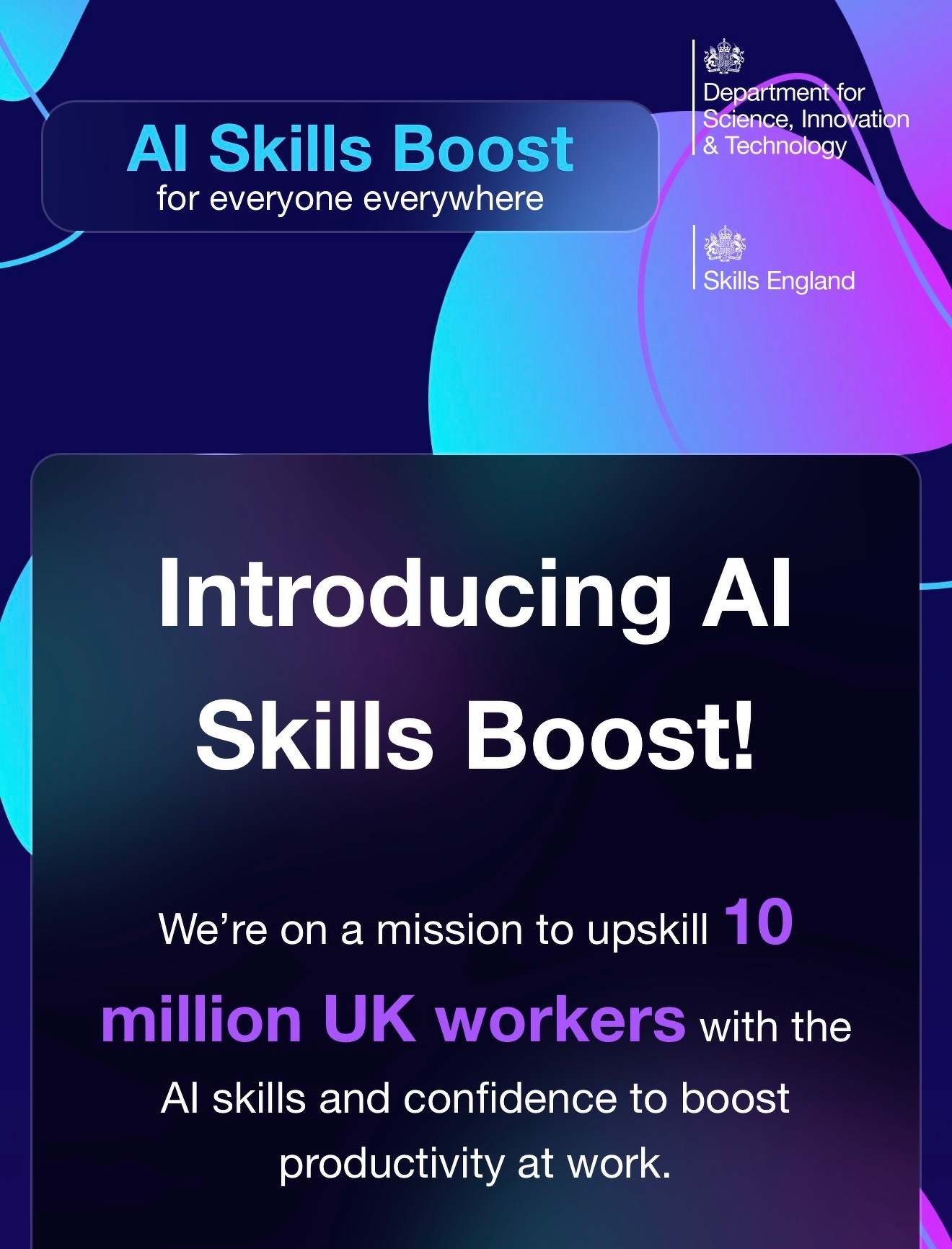
On 28 January 2026, the UK Government launched an expanded AI Skills Hub with the ambitious goal of upskilling 10 million workers by 2030. Backed by £27 million in public funding and partnerships with 25+ organisations, this initiative has been presented as Britain’s answer to the AI skills crisis. However, a closer examination reveals fundamental flaws in both design and execution that risk undermining the very goals the programme seeks to achieve.
This analysis, written from the perspective of an award-winning EdTech provider with proven results in AI upskilling, identifies three critical problems:
-
The Hub is essentially a publicly funded directory for tech company marketing materials that already exist freely elsewhere, representing poor value for taxpayers and potentially enriching multinational corporations without delivering genuine educational outcomes.
-
Every single course provider is a technology company, not an education specialist. This perpetuates the damaging misconception that AI is a technical skill requiring technical knowledge, when it is fundamentally about human skills like communication, delegation, and critical thinking.
-
The programme’s infrastructure reveals its true nature as a box-ticking exercise for pre-existing Innovate UK BridgeAI funding, focused on four specific sectors whilst paying lip service to broader workforce upskilling.
Most concerningly, there is not a single pedagogy-first, human-centred training provider among the 25+ partners. The absence of actual educators from an education initiative represents a fundamental category error that will likely result in low completion rates, minimal behaviour change, and continued resistance to AI adoption among the very SMEs and non-technical workers the Hub claims to serve.
Introduction: The Promise and the Reality
When Technology Secretary Liz Kendall took to the stage at Bloomberg HQ on 28 January 2026, her message was clear and compelling: “We want AI to work for Britain, and that means ensuring Britons can work with AI.” The expanded AI Skills Hub, she announced, would provide free, benchmarked courses to upskill 10 million workers, equivalent to nearly a third of the UK’s workforce. This, the government proclaimed, represented “the biggest targeted training programme since Harold Wilson started the Open University.”
The scale of ambition is admirable. The need is undeniable. With only 21% of UK workers feeling confident using AI at work, and just one in six UK businesses having adopted AI by mid-2025, there is clearly a significant skills gap that threatens Britain’s economic competitiveness. The government estimates that increasing AI adoption could unlock up to £140 billion in annual economic output.
However, ambition without effective execution risks becoming expensive theatre. As someone who has spent the past two years delivering government-funded AI training programmes across the Southwest UK, training over 150 businesses through face-to-face Generative AI Skills Bootcamps and Automation Skills Bootcamps, I have seen firsthand what works and what does not in AI education. And what I see in the AI Skills Hub concerns me deeply.
Problem 1: Publicly Funded Tech Company Marketing
The Hub as an Aggregation of Existing Free Content
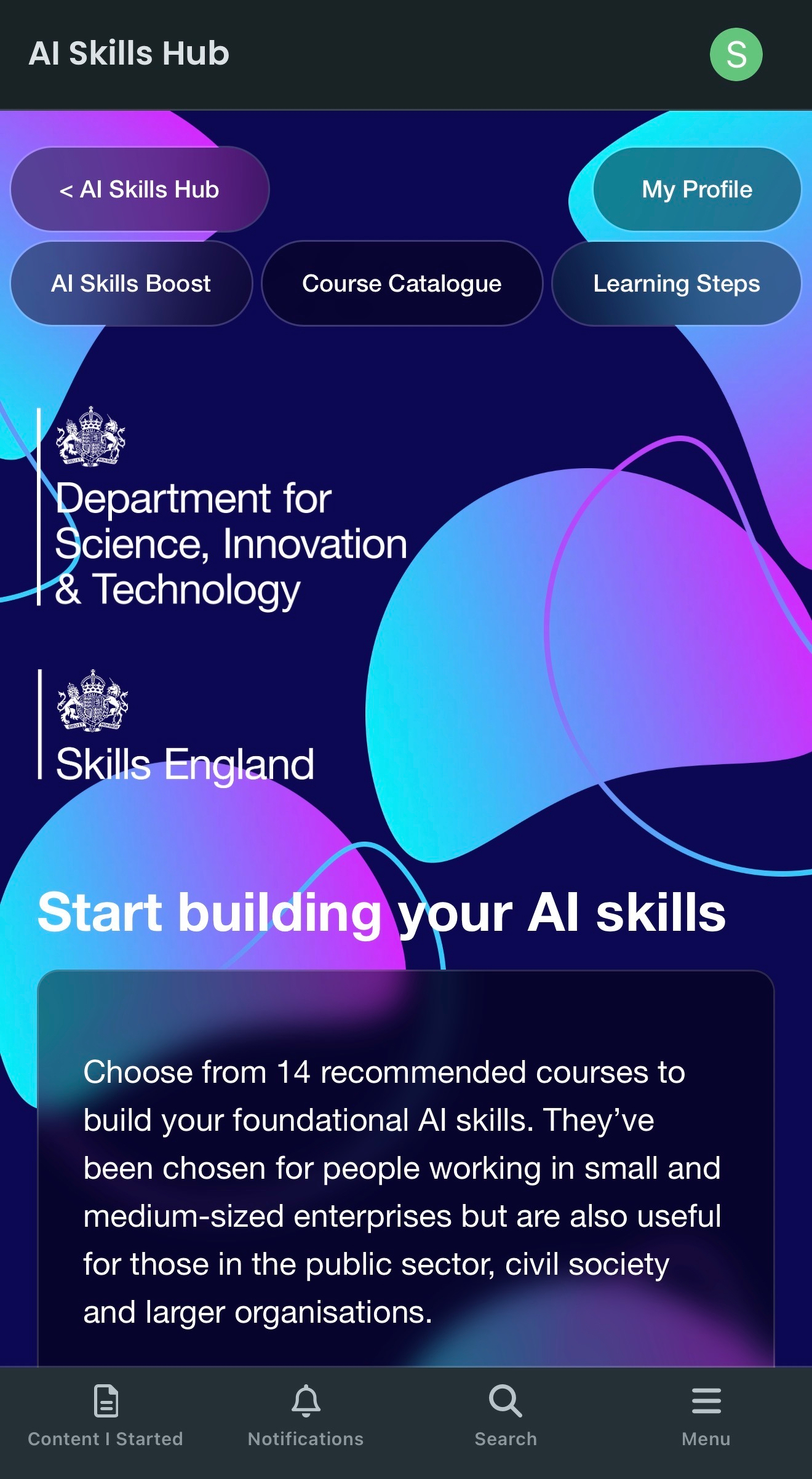
The AI Skills Hub currently offers 14 “recommended courses” that have been “selected for alignment with Skills England’s AI Foundation Skills for Work Framework.” This sounds impressive until you examine what these courses actually are and where they come from.
Every single course I viewed is content that already exists freely on the provider’s own platform:
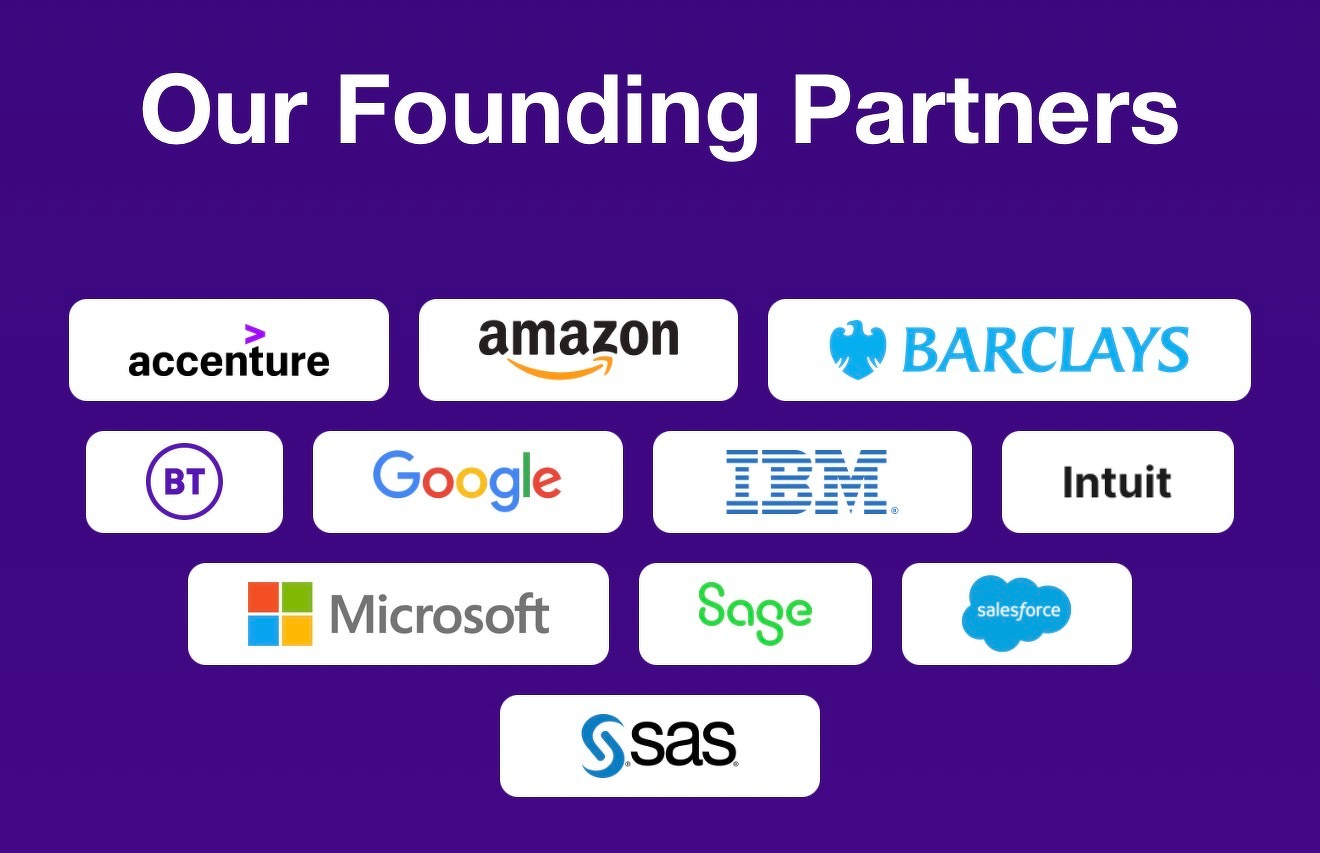
- Accenture’s Digital Skills: Artificial Intelligence and Mastering Prompting courses
- Google’s Introduction to Generative AI and Gen AI: Beyond the Chatbot learning paths
- IBM SkillsBuild courses including Getting Started with AI and AI Fundamentals
- Microsoft and Founderz’s Learn AI for Business Success programme
- Amazon Web Services’ Generative AI Essentials series
- Salesforce Trailhead modules on AI implementation and responsible AI
- Sage’s AI Fundamentals for Business pathway
- SAS’s Responsible Innovation and Trustworthy AI course
None of this content was created for the Hub. None of it is exclusive. All of it has been available for free, often for years, on the providers’ own platforms. The government has not commissioned new educational content; it has created a portal that directs users to existing marketing materials.
Commercial Interests Masquerading as Public Service
Understanding the business model behind these “free” courses is crucial to understanding why this approach is problematic. Each of these companies has a clear commercial interest in the content they provide.
Tool vendors (Microsoft, Google, Salesforce, Sage) naturally emphasise the use of their own AI tools and platforms.
Cloud infrastructure providers (Amazon, IBM) teach AI concepts through their ecosystems, encouraging platform dependency.
Consulting firms (Accenture, Cognizant) position complexity and transformation as problems requiring paid expert guidance.
 This creates an inherent conflict of interest. The content is designed to serve the provider’s commercial objectives, not necessarily the learner’s educational needs. An effective AI course should teach platform-agnostic principles and empower learners to make informed choices. Instead, these courses subtly funnel learners toward specific commercial ecosystems.
Where Did the £27 Million Go?
If the courses themselves are pre-existing and freely available, what exactly did taxpayers pay for?
The funding reportedly supports the TechLocal scheme, professional practice courses, and graduate traineeships. However, the Hub itself appears to be primarily a coordination and marketing effort:
- Creating an aggregation website
- Developing the Skills England AI Foundation Skills for Work Framework
- Designing virtual badges
- Marketing the initiative
- Engaging PwC as delivery partner for BridgeAI
Meanwhile, proven local training providers have seen funding cuts. In Somerset alone, Skills Bootcamp funding reportedly dropped by 68%, from over 1,100 learners to just 380 in 2026–27. Nationally there a cut of £80 million in courses that could provide hand on, real world, business first training. The irony is stark: cutting funding to providers with proven outcomes whilst spending millions aggregating corporate marketing materials.
Problem 2: The Absence of Pedagogy and Human-Centred Design
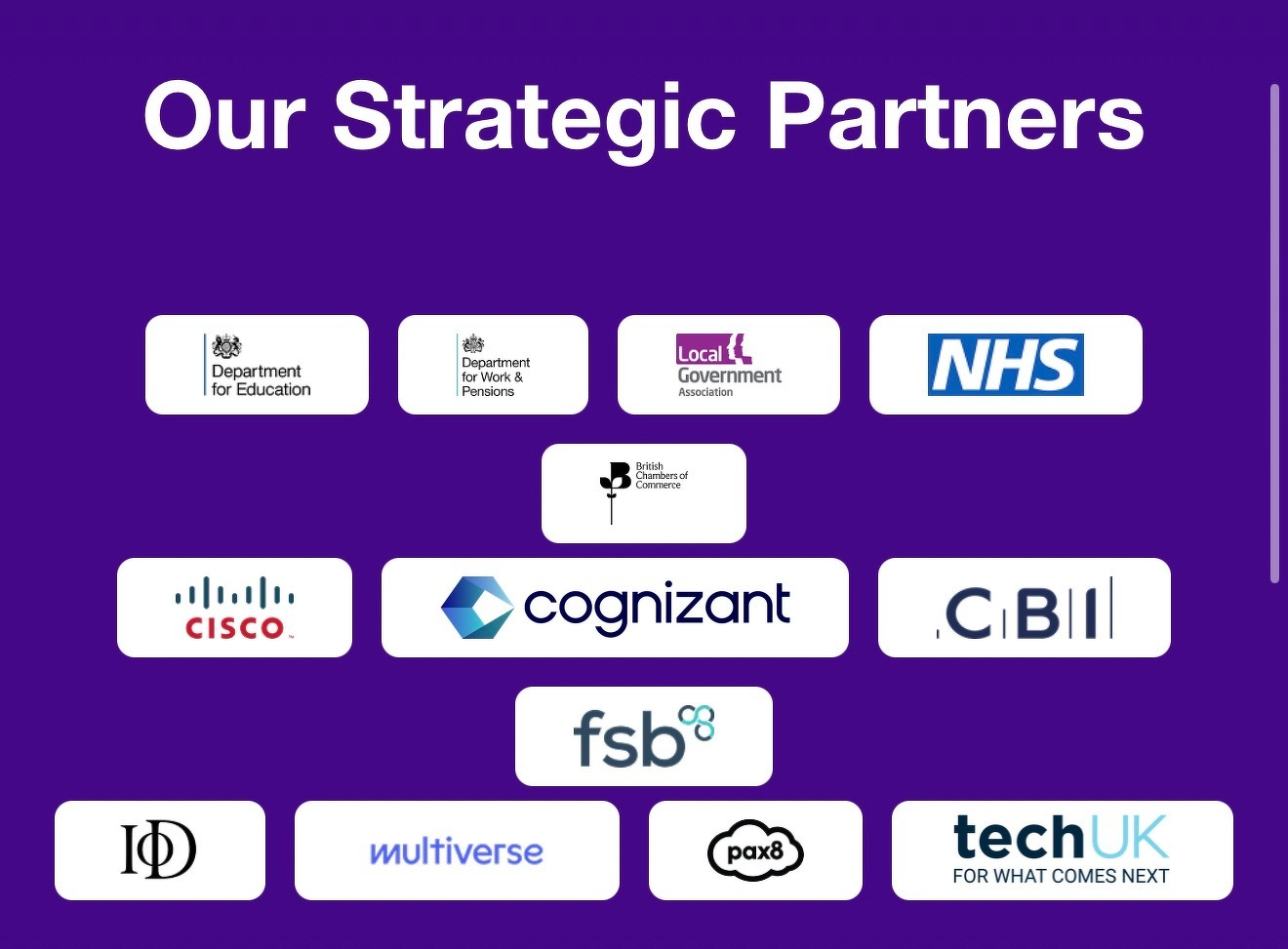
Not a Single Education Specialist Among 25+ Partners
The founding and strategic partners include technology vendors, consultancies, business organisations, and government departments. There is only one organisation whose core business is education: Multiverse, an apprenticeship provider.
 There are:
- No universities
- No FE colleges
- No pedagogy-first EdTech providers
This is equivalent to launching a national motor driving skills programme and partnering exclusively with car manufacturers, with no driving instructors involved..
The “Tech for Techies” Problem
Technologists design content for people like themselves. This leads to courses that are technically accurate but misaligned with the needs of non-technical workers.
Examples include immediate dives into:
- Large language models and transformers
- Neural networks and deep learning architecture
These topics are irrelevant and intimidating for most workers who simply want to use AI to improve their day-to-day work.
The fundamental error is treating AI literacy as a technical skill rather than a human one.
Why AI Education Cannot Be Left to Technologists
AI touches every profession. There will be HR with AI, sales with AI, healthcare with AI, education with AI. The implication is clear: AI should be taught by domain experts who use it, not by technologists who build it.
A Microsoft engineer cannot effectively teach a geography teacher how to use AI in the classroom. That requires an educator who understands both pedagogy and AI in context.
The Hub’s courses provide generic AI knowledge without domain expertise. They teach prompts in the abstract, not in professional context. This is why the absence of sector-specific educators and professional bodies is such a serious flaw.
What Actually Works: The Human-Centred Approach
After training over 150 businesses across the Southwest, we have learned what works:
- AI is a communication skill, not a technical one
- Start with play, not work
- Focus on indirect tasks and job satisfaction
- Hands-on, immediate application
- Face-to-face and blended delivery
Online-only courses typically achieve single-digit to low-teens completion rates. Instructor-led and cohort-based programmes consistently outperform them in engagement, retention, and real-world adoption.
These are not minor stylistic differences. They reflect fundamentally different understandings of how adults learn and how AI adoption actually happens.
The Self-Help Fallacy: Why Individual Learning Doesn’t Equal Business Adoption
Even when self-paced online courses are well-designed and pedagogically sound, they face a fundamental limitation: they treat AI upskilling as an individual challenge when it is fundamentally an organisational one.
In practice, short online courses can work well as self-help foundations. They build awareness, demystify the technology, and give individuals basic confidence with AI tools. For someone exploring AI in their personal life or wanting to understand the fundamentals, these courses serve a valuable purpose.
However, translating that individual learning into sustained business adoption is where organisations consistently struggle. And this is the implementation gap that the AI Skills Hub entirely overlooks.
The Three Essential Elements for Business AI Adoption
Real business transformation with AI requires three critical elements that self-help courses cannot provide:
1. Leadership Encouragement from the Top
Employees need to see their managers and senior leadership actively using AI, talking about it positively, and making it a strategic priority. Without visible commitment from the top, AI remains a “nice to have” rather than a business imperative. Leaders must:
- Model AI use in their own work
- Allocate protected time for learning and experimentation
- Celebrate AI wins and share success stories
- Remove barriers to adoption
- Make AI literacy part of performance expectations
When an employee completes an online AI course but returns to a workplace where no one else is using AI and leadership shows no interest, the learning evaporates within weeks.
2. Permission to Apply AI in Day-to-Day Work
This is perhaps the most overlooked element. Many employees complete AI training but face:
- Unclear policies about what AI tools they’re allowed to use
- Concerns about data privacy and security that no one addresses
- Fear of making mistakes or being seen as replacing human work
- Lack of clarity about when AI use is appropriate vs inappropriate
- Worry about job security if they automate their own work
Organisations need to create explicit permission structures: “Yes, you are encouraged to use AI for these types of tasks. Here are our guidelines. Here’s how we handle data. Here’s what good looks like.”
Without this psychological safety and structural permission, learning remains theoretical rather than practical.
3. Ongoing Training, Not One-Off Modules
AI tools evolve rapidly. Use cases expand continuously. Initial training teaches the basics, but sustained competence requires:
- Regular refresher sessions as tools evolve
- Context-specific coaching for sector or role applications
- Troubleshooting support when implementation challenges arise
- Community of practice where colleagues share discoveries
- Advanced training as people move beyond foundations
One-off courses create a spike of knowledge that decays over time. Ongoing support creates a learning culture that compounds capability.
Why the Hub’s Approach Will Fail at This Level
The AI Skills Hub directs individuals to complete self-paced courses with no consideration of organisational context. There is:
- No engagement with leadership teams
- No support for creating permission structures
- No ongoing coaching or community of practice
- No sector-specific implementation guidance
- No measurement of actual workplace adoption
An individual might complete a Google course on prompt engineering, receive their virtual badge, and return to a workplace where:
- Their manager doesn’t understand or value AI
- Company policy prohibits using the tools they just learned about
- No one else in the organisation is experimenting with AI
- There’s no time or permission to apply their new knowledge
- There’s no support when they encounter challenges
Within a month, that learning becomes dormant. Within three months, it’s forgotten.
What This Means for SMEs Specifically
The Hub claims to focus on SMEs, where AI adoption lags behind larger organisations. But SMEs face unique challenges that make the self-help approach particularly ineffective:
Resource Constraints: SME employees don’t have dedicated time for professional development. They need training that fits around operational demands, not self-paced courses they’re supposed to complete in their spare time.
Leadership Proximity: In SMEs, if the owner or managing director isn’t driving AI adoption, it won’t happen. The Hub makes no attempt to engage SME leadership.
Implementation Support: SMEs often lack internal IT support or technical expertise. They need hand-holding through implementation, not just foundational theory.
Peer Learning: SMEs benefit enormously from seeing how other similar businesses in their sector have successfully adopted AI. Generic courses provide no sector-specific or peer-to-peer learning.
Risk Aversion: SMEs are often more cautious about new technology due to limited resources to recover from mistakes. They need guidance through their specific concerns, not generic best practices.
The Evidence from Our Delivery Model
Our courses, training, mentoring, and consultancy options succeed precisely because we address all three essential elements:
We Engage Leadership: Sessions include business owners and senior managers, ensuring they understand AI’s strategic value and their role in enabling adoption.
We Create Permission: We help organisations develop clear AI use policies, address data concerns, and establish guidelines for appropriate use. Participants leave knowing exactly what they’re allowed and encouraged to do.
We Provide Ongoing Support: Our programmes include follow-up sessions, access to a community of safe, practice, sector-specific implementation workshops, and ongoing troubleshooting support. Learning continues well beyond the initial training.
The result? Measurable workplace adoption, productivity improvements, and sustained behaviour change. Not just completed courses and virtual badges.
The Fundamental Category Error
The AI Skills Hub has confused information provision with capability building. It has assumed that if you give people access to learning resources, adoption will follow naturally.
This misunderstands how organisational change happens. Skills development is not just about individual knowledge acquisition; it’s about:
- Creating supportive organisational culture
- Building communities of practice
- Providing structured implementation pathways
- Addressing barriers to adoption
- Measuring and reinforcing behaviour change
None of this happens through self-help solo online courses, no matter how well-designed.
An Honest Assessment
Self-help courses are not worthless. They have their place in the learning ecosystem, we even offer an online course ourselves. But the government and AI Skills Hub positioning them as the primary mechanism for national workforce transformation reveals a fundamental misunderstanding of how business adoption actually occurs.
If the government genuinely wants to upskill 10 million workers in AI and see that translate into increased productivity and economic growth, it needs to fund approaches that address organisational adoption, not just individual learning.
That requires partnering with providers who understand change management, who work with businesses not just individuals, who provide ongoing support not just one-off modules, and who measure workplace outcomes not just course completions.
The AI Skills Hub, in its current form, is optimised for generating impressive participation statistics. It is not optimised for generating genuine business transformation.
And that is why, despite impressive announcements and prestigious partnerships, it is sadly likely fail to achieve its stated goals.
Problem 3: Box-Ticking for BridgeAI, Not Genuine Workforce Development
The Four Sector Focus Reveals the True Agenda
Despite claims of being open to all UK adults, the Hub’s onboarding focuses on four sectors:
- Agriculture and food processing
- Construction
- Creative industries
- Transport, logistics, and warehousing
These align exactly with Innovate UK’s BridgeAI priorities. Everyone else falls into “Other”.
This reveals the Hub’s real purpose: supporting a pre-existing sector programme, not genuinely upskilling the entire workforce.
PwC as Delivery Partner: Who Benefits?
PwC operates the Hub on behalf of Innovate UK. As a major AI consulting firm, it has a commercial interest in maintaining the perception that AI adoption is complex and requires expert intervention. This creates unavoidable tension between accessibility and consultancy-driven delivery.
The NHS Partnership: Concerning Priorities
Healthcare professionals need sector-specific AI training, designed around clinical workflows, patient safety, and NHS systems. Generic vendor courses are not fit for purpose in healthcare contexts.
The Bigger Picture
The AI Skills Hub follows a familiar pattern: ambitious announcements, prestigious partnerships, significant funding, but shallow delivery. Unlike the Open University, it has not created new content, new pedagogy, or new education infrastructure.
The opportunity cost of £27 million is significant. That funding could have supported regional bootcamps, FE integration, sector-specific materials, and face-to-face learning at scale.
Conclusion: A Call for Expansion, Not Abandonment
This is not a call to abandon the AI Skills Hub. It is a call to expand it.
The Hub can succeed if it:
- Adds pedagogy-first education partners
- Includes domain experts alongside technologists
- Supports multiple delivery models
- Commissions purpose-built content
- Addresses organisational adoption, not just individual learning
- Measures outcomes, not participation
We do not need to choose between technology companies and educators. We need both.
Techosaurus LTD stands ready to contribute our expertise, proven methodology, and track record to this national effort. The same is true for many overlooked providers across the UK.
Upskilling 10 million workers is achievable, but only if the government partners with organisations that know how to teach, not just how to build technology.
About Techosaurus LTD
Techosaurus LTD is an award-winning EdTech company delivering government-funded AI and automation training programmes across the Southwest UK. Named EdTech Provider of the Year (Tech South West) and Business of the Year for Best Use of Technology (Somerset Chamber) in 2025, the company has trained over 150 businesses through its Generative AI Skills Bootcamp and Automation Skills Bootcamp programmes.