AI in Education: Why the Co-Tutor Could Change Everything
Udemy’s new integration with ChatGPT got me properly fired up this week. Not because of the integration itself, although that’s genuinely cool, but because it opens a door to something I’ve been thinking about for a long time: what would education look like if we actually used AI well?
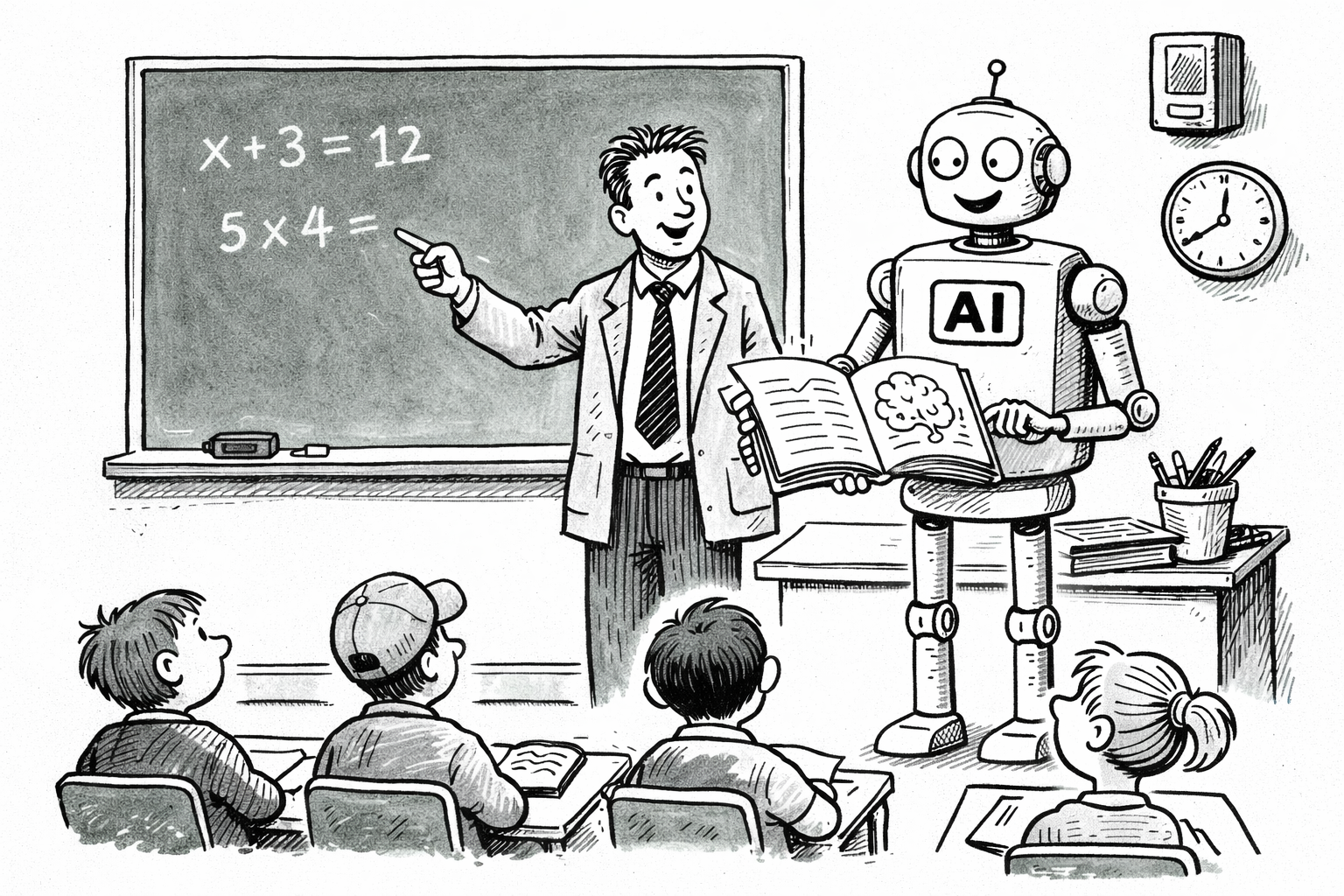
Let me be clear before anyone jumps down my throat. I’m not talking about replacing teachers. I’m not talking about putting a robot at the front of the classroom. I’m talking about giving teachers the most powerful teaching assistant they’ve ever had.
The Problem That Hasn’t Changed Since We Were at School
Here’s the thing about education: it hasn’t really changed. Not since I was at school, and probably not since my parents were at school either. The system is still fundamentally built around one question: what information can you retain? That’s it. That’s the test. Can you memorise enough stuff to write it down in an exam room without access to a calculator or the internet?
But when in the rest of your life are you ever in that situation? When does your boss say, “Right, I need you to solve this problem, but you’re not allowed to look anything up or use any tools?” It doesn’t happen. It’s a false scenario. And yet that’s still the foundation our entire education system is built on.
What the Udemy x ChatGPT Integration Actually Shows Us
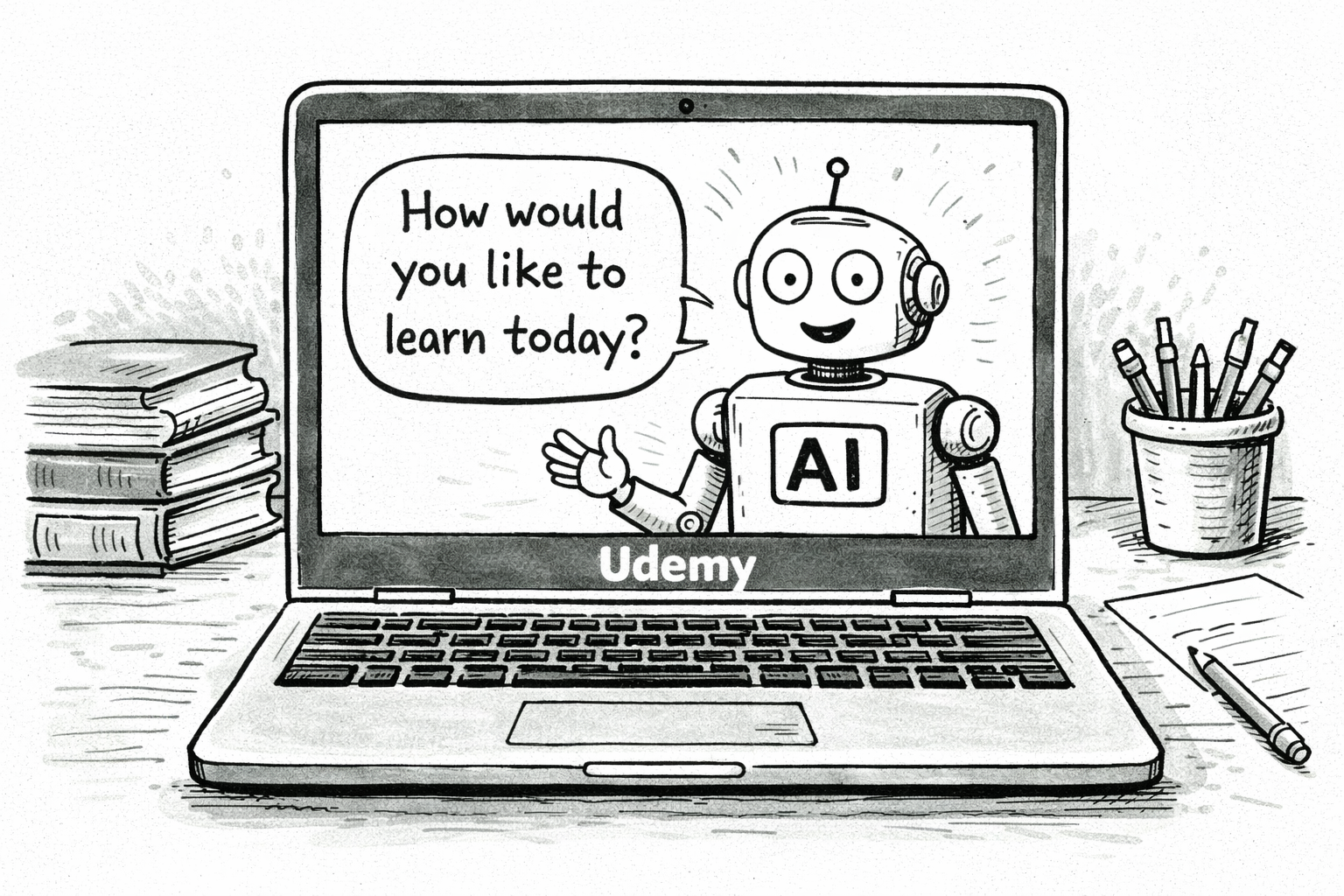
The Udemy partnership embeds over 290,000 courses directly into ChatGPT. But the real magic isn’t in finding a course. It’s in what happens next. Because once AI has access to proper, expert-curated educational content, it can do something that no course platform and no single teacher can realistically do: differentiate for every single learner, in real time.
I was discussing this on Prompt Fiction only this week, and I used the example of someone doing a course who’s just not getting it. The material is well written, but it’s not landing. With AI in the mix, you could say “I don’t understand this. Can you explain it differently?” And the AI might ask you what you’re into. You say you love WWE, and suddenly it’s teaching you the concept using wrestling as the framework. Udemy can’t write that course for a thousand different audiences. AI can do it instantly.
Sources: Udemy Press Release (11 Feb 2026), PYMNTS.com (11 Feb 2026)
The Co-Tutor
What I’d love to see is AI used as what I’m calling a Co-Tutor. Not a replacement for the teacher, but a one-to-one companion for every student in the class.
Think about what a teacher actually faces. A classroom of 30 to 40 kids. Every single one of them needs a different level of support and differentiation. Some are loud and will tell you exactly what they need. Some are incredibly quiet and you’ll have no idea where they’re at. So the teacher ends up shooting down the middle. Some kids get stretched. Others get left behind. It’s been that way forever, and it’s not the teacher’s fault. It’s an impossible ask.
Now imagine each student has a Co-Tutor. An AI that knows the curriculum (because the teacher has fed it their lesson material), understands how that particular student learns (because it’s been working with them over time), and can adapt in real time. It doesn’t do the work for them. It interviews them, asks questions, explores their thinking, and gently leads them to make their own conclusions.
Meanwhile, the AI feeds back to the teacher. Gap analysis. Which students are struggling. Where the common misunderstandings are. Which kids might need more support. No child gets overlooked because they’re too quiet. No child falls through the cracks because they didn’t put their hand up.
And think about the reporting. The Co-Tutor could write reports on how each student is picking things up, flag where there are weaknesses, highlight strengths. It keeps a human in the loop by raising things to the teacher’s attention, giving them more space and less head trash so they can really focus on the students who need them most.
The “But They’ll Just Get AI to Do Their Work” Objection
I hear this constantly. And my response is always the same: if a student can just ask AI to write their essay and hand it in, then we need to ask better questions. If the assessment can be done entirely by AI, maybe the assessment isn’t testing the right things.
We already have maths papers with a calculator and maths papers without. We can absolutely do the same thing with AI. Test what you can do without tools, sure. But also test what you can do when you’ve got the right tools. Because that’s the real world. If everybody’s got the same tools, we raise the bar and we test for being able to use those tools effectively.
Building It Gradually
I know educators are overworked, underpaid, and don’t have enough time. I’m not suggesting they overhaul everything overnight. What I’d suggest is this: start with one lesson a week. Build that AI-assisted lesson with proper support and guidance. By next year, that lesson’s already baked in and ready to go. Then add one more. Slowly, gradually, you build up a library of AI-enhanced lessons without burning anyone out.
But they need to see what it looks like first. They need to be shown, supported, and given permission to experiment. And I think this Udemy and ChatGPT integration, where millions of people will start experiencing AI-assisted learning in a mainstream way, might be the thing that starts that conversation properly.
The Future Belongs to the Curious
I’m not looking at a world where teachers are replaced by robots. Even in Star Wars, where they’ve had robot teachers since the original trilogy, the real learning happens through relationships. You still need facilitators. You still need people to teach social skills, emotional intelligence, and all the things that make education about more than just information.
But if we could give every teacher a Co-Tutor, a super-powered teaching assistant that never gets tired, never loses patience, and can personalise learning for every student simultaneously? I think that’s one of the most exciting things AI could do for society. And as someone who spends every day at Techosaurus helping people use AI practically and confidently, I’d love to be part of making it happen.
I discussed this topic in depth on the latest episode of Prompt Fiction. Listen to Chapter 11, Part 1 here.
Scott Quilter | Co-Founder & Chief AI & Innovation Officer, Techosaurus LTD