The Chip That Changes the Conversation About AI and the Environment
Every time AI comes up in conversation, someone mentions the environmental cost. How much water it uses. How much energy. How much power these data centres gobble up. And they’re not wrong, at least not today. But the story people are telling is based on a snapshot, and the picture is changing fast.
What Actually Happened
OpenAI released GPT-5.3-Codex-Spark in February 2026, a lighter, faster version of their coding assistant. That alone isn’t earth-shattering. What is earth-shattering is what’s running it: not NVIDIA GPUs, but Cerebras’ Wafer Scale Engine 3. This is a single silicon wafer, about the size of a dinner plate, packed with 900,000 AI cores, 44GB of on-chip memory, and capable of delivering over 1,000 tokens per second.
I tried to explain petaflops on Prompt Fiction’s last episode (and somehow managed not to lose Reece entirely). A petaflop is one quadrillion calculations per second. Write down the number one and put 15 zeros after it. That’s a petaflop. If every person on earth did one calculation per second, it would take us many, many years to match what a petaflop machine does in a single second. The Cerebras WSE-3 can deliver 125 petaflops. From one chip.
Sources: TechCrunch (12 Feb 2026), Cerebras Blog (12 Feb 2026), The Register (12 Feb 2026)
Why This Matters for the Environment
Most AI today runs on NVIDIA graphics processors. These were designed to push pixels around for video games and 3D animation. They were never designed for AI. They work, and they work well, but they’re like using a V8 muscle car to do the school run. Yes, it gets you there. No, it’s not efficient.

What Cerebras and others are building is purpose-made silicon for AI workloads. If you can get 10 to 20 times the throughput for roughly a third less cost and significantly less energy per token, the maths changes dramatically. It’s greener. It’s cheaper. It’s faster. And to the end user? It still feels instant.
Compare the NVIDIA approach to the Cerebras approach. NVIDIA’s NVL 72 is a full rack of 72 graphics cards, all connected together with a mesh interface so they can act as one big processor. That’s a lot of power, a lot of heat, and a lot of resources. The Cerebras chip? It’s just one wafer. One device. And it’s outperforming the rack on the workloads it’s designed for.
OpenAI themselves were careful to frame this: GPUs remain foundational for training, but for inference (the process of actually generating responses), specialised chips can deliver results with dramatically lower latency and energy consumption.
Sources: VentureBeat (12 Feb 2026), Tom’s Hardware (13 Feb 2026)
The Narrative Is Still Being Written
I said on the podcast that we can’t hold onto today’s energy stats as though they’re permanent. When trains first came out, we shovelled coal into them. Look at Japanese trains now that hover on cool magnets. Technology evolves, and AI’s infrastructure is evolving faster than almost anything we’ve seen.
OpenAI’s $10 billion deal with Cerebras isn’t a one-off experiment. Google are developing their own custom TPU chips. The entire industry is moving towards purpose-built hardware that does one thing exceptionally well rather than repurposing general-purpose processors.
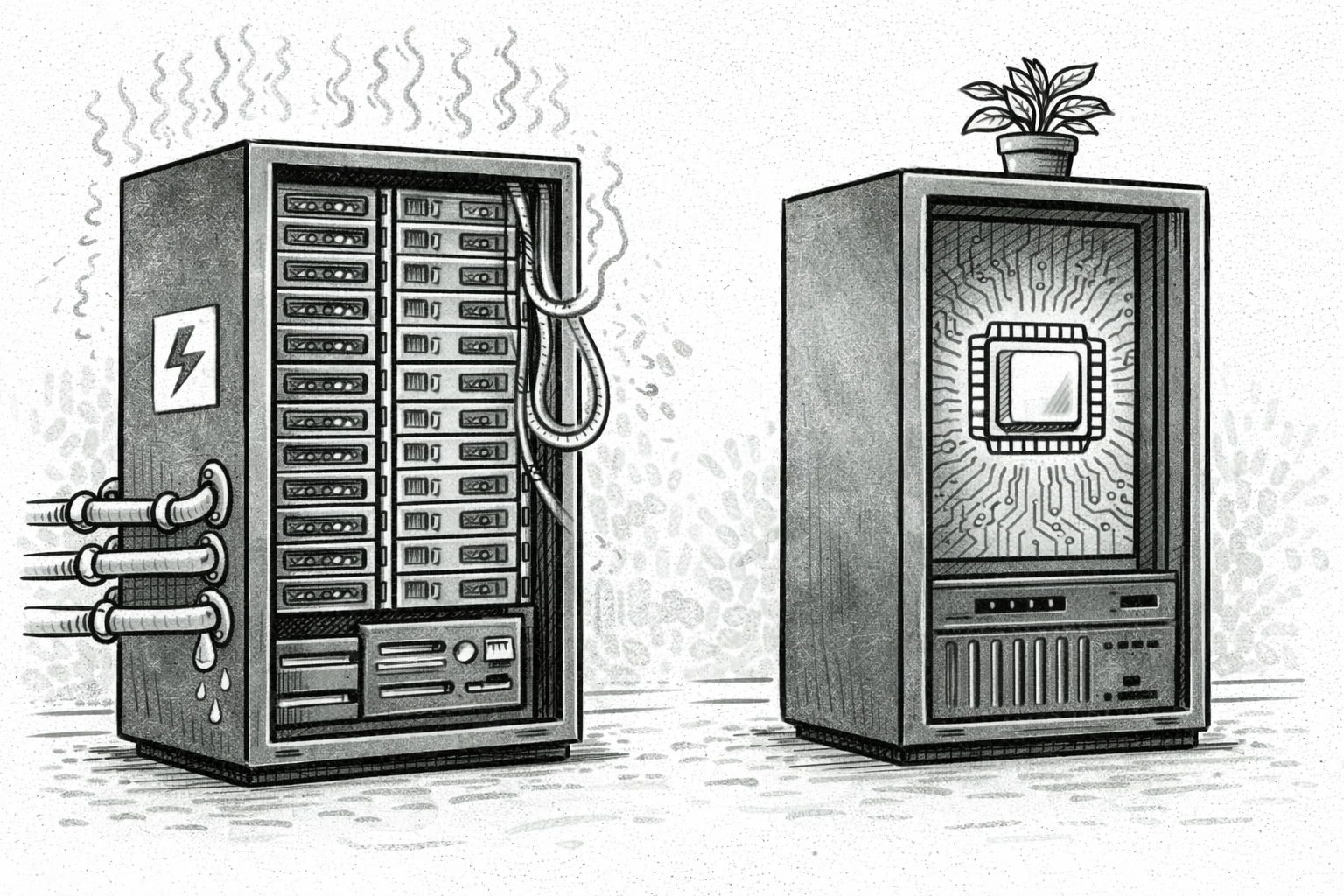
This is something I talk about a lot at Techosaurus when we’re working with businesses. The stats people quote about AI’s environmental impact are real, but they’re usually yesterdays stats. Not today’s. Not tomorrow’s. Not next year’s. The trajectory is heading in the right direction, and it’s heading there quickly.
So the next time someone tells you AI is terrible for the environment, the honest answer is: it’s not great today, but it’s better than it was, and the people building the chips are already solving it. The people who lock in today’s stats as permanent facts are going to look very outdated very soon.
I discussed this topic on the latest episode of Prompt Fiction. Listen to Chapter 11, Part 1 here.
Scott Quilter | Co-Founder & Chief AI & Innovation Officer, Techosaurus LTD