Ads Are Coming to AI. Here's Why That Matters More Than You Think.
We’ve been advertised to our entire lives. Doctors used to appear in cigarette ads. Every TV show and film you watch has product placement baked in. There’s a convention that bad guys in films don’t use Apple devices, because Apple pays to keep their products associated with the heroes. When you know that, you can’t un-know it, and every iPhone on screen becomes a little signal about whose side a character is on. We live in a world where rugby matches now run full animated adverts in a panel beside the live action while the game is still playing.
None of this is new. Advertising changes shape. It finds new surfaces. It always has.
What’s new is the surface it’s found now.
What’s Actually Happening
OpenAI announced in January 2026 that they’d be testing advertising in ChatGPT for users on the free tier and the $8 per month Go plan. Paid subscribers on Plus, Pro, Business and Enterprise stay ad-free. The ads appear below responses, clearly labelled, visually separated from the conversation itself. OpenAI has been explicit that ads do not influence the answers ChatGPT gives. Early pricing has been reported at around $60 per thousand impressions, with a minimum commitment of $200,000. For context, that puts it in the same bracket as premium television and live sports. Not banner ads. Not cheap inventory. Something advertisers are treating as significant reach into high-attention moments.
Sources: OpenAI’s advertising statement (Jan 2026), AdTechRadar on $60 CPM pricing (Jan 2026)
Anthropic’s Response
Four days after the announcement, Anthropic published a blog post called “Claude is a space to think.” The headline position was simple: Claude will remain ad-free. But the reasoning behind it was more interesting than a simple competitive stance.
Anthropic’s argument was that AI conversations are meaningfully different from search results or social feeds, where we expect a mixture of organic and sponsored content and have built mental filters for it. The conversations people have with AI are often personal. Sensitive. The kind of thing you’d discuss with a doctor or a trusted advisor. Dropping advertising into that context would change the nature of the space. And more importantly, even ads that don’t influence responses directly would introduce an incentive to optimise for engagement rather than genuine usefulness. The most helpful AI interaction might be a short one. An ad-supported model wants you to stay longer.
Source: Anthropic: Claude is a space to think (4 Feb 2026)
They then went and spent approximately $8 million making Super Bowl ads to make that point very loudly indeed.
The four spots, released on 4 February and aired during Super Bowl LX on 9 February, were titled BETRAYAL, VIOLATION, TREACHERY, and DECEPTION. Each one showed a helpful AI assistant pivot mid-conversation into an absurd product pitch. An AI therapist segued from relationship advice into a dating site recommendation. An AI coach helping someone get fit suddenly pushed shoe insoles for “short kings.” An AI academic celebrating a good essay steered a student toward a jewellery purchase. Each ended with the same tagline: “Ads are coming to AI. But not to Claude.”
They are genuinely, brilliantly funny. Whoever directed them (it was Jeff Low, working with agency Mother) understood exactly how to make the AI persona feel correctly uncanny: just slightly too content, just slightly too quick with the pivot, a small unsettling grin throughout. The choice of soundtrack is chef’s kiss. I showed them in class and was asked to play them again.
Sources: SF Standard on the Super Bowl campaign (4 Feb 2026), CNN on the OpenAI/Anthropic feud (6 Feb 2026)
Sam Altman’s Pushback
OpenAI CEO Sam Altman called the ads “funny but clearly dishonest.” His broader argument: OpenAI has 800 million weekly users, most of whom pay nothing. To bring AI to billions of people who can’t afford subscriptions, you need another revenue model. Advertising is that model. “Anthropic serves an expensive product to rich people,” he wrote. “We are glad they do that, and we are doing that too, but we also feel strongly that we need to bring AI to billions of people who can’t pay for subscriptions.”
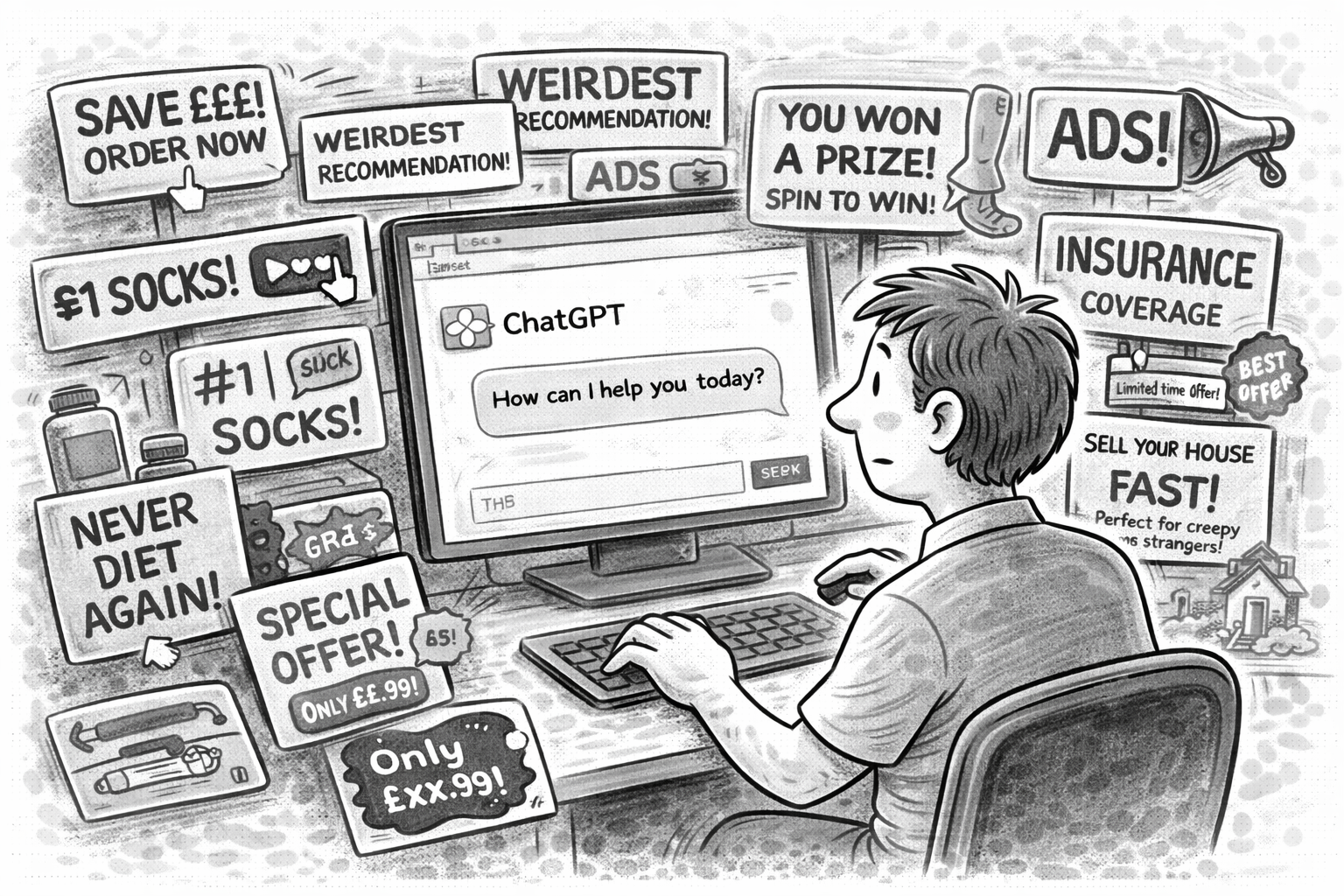
That’s a legitimate argument. Access matters. The question is whether ad-supported AI is genuinely the right mechanism to deliver it, or whether it’s the mechanism that happens to benefit the company the most.
Source: Fortune on the OpenAI/Anthropic rivalry (9 Feb 2026)
My Honest Take
Here’s where I land on this, and I want to be clear that I don’t think this is straightforward.
ChatGPT’s actual implementation, at least as it exists today, is far more considered than Anthropic’s ads imply. Ads below the fold, clearly labelled, not shaping the response, that’s quite different from an AI therapist pivoting to a dating site. The dramatisation in Anthropic’s Super Bowl spots is effective precisely because it represents a worst-case scenario, not what OpenAI is actually doing.
But Anthropic’s deeper point is the one that keeps me thinking. The concern isn’t day one. It’s what advertising looks like five years from now once it’s embedded into revenue targets and product development. The history of ad-supported platforms is that the incentives expand. What starts as a labelled banner below the fold tends, over time, to find its way into the experience in ways that weren’t initially promised. That’s not cynicism. That’s just how ad-supported businesses work. The platform needs to maximise the value of your attention, and that need influences decisions at every level.
I remember when BMW swore they would never make a front-wheel drive car. You can buy one now.
Anthropic have left a small caveat in their blog post: “Should we need to revisit this approach, we’ll be transparent about our reasons for doing so.” It’s a commitment, not a guarantee written in stone. I hope they hold the line. But I’ve seen enough promises from technology companies to know that integrity under financial pressure is genuinely hard to maintain, and I wouldn’t stake my trust on it uncritically.
The Bit That Really Unsettles Me
There’s a Black Mirror episode, and if you haven’t seen it, I’d recommend it: a man’s partner dies, and her consciousness gets streamed from a server. The affordable tier of the service means that every so often, in the middle of a conversation, she breaks into what is effectively an advertisement. He calls customer service. They inform him that his current plan is ad-supported. He can upgrade to the premium tier for an ad-free experience.
It’s supposed to be a horror. When I watched it again last week, it didn’t feel as distant as it did when it first aired.
The version of this that worries me isn’t the grotesque Black Mirror version. It’s the subtle one. The AI that’s built to help you think and work and make decisions, but that has, baked somewhere deep in its optimisation, an incentive to keep you engaged, to surface monetisable moments, to steer you toward products in ways that feel like advice. Not because it’s malicious. Because that’s what the incentive structure rewards.
The moment your AI is working partly for an advertiser, it is, at least in part, no longer working purely for you.
What This Means Right Now
For most people using free-tier ChatGPT, the practical impact of the current ads rollout is pretty minimal. The ads are below the conversation, not in it. You can ignore them. If it bothers you, the paid tiers remain ad-free.
The more important thing to watch is what comes next. Whether the line holds. Whether other AI platforms follow. Whether we start to see “native” ad formats that are harder to spot. Whether, in three years, we’ve become so accustomed to ad-adjacent AI that we stop noticing the moment the thing guiding our decisions stopped being purely on our side.
AI is becoming the interface through which a lot of people think. That makes it worth paying attention to who is funding the thinking.
I discussed this topic on the latest episode of Prompt Fiction. Listen to Chapter 11, Part 2 here.
Scott Quilter | Co-Founder & Chief AI & Innovation Officer, Techosaurus LTD