When AI Gets It Wrong, That's Your Fault
There is a prompt doing the rounds on the internet right now. It goes like this: I want to wash my car. My car is at home. The car wash is 100 metres away. Should I walk or drive?
People are sharing it to laugh at AI. To point and say, look, look, see, it gets confused. And they’re right, it does get confused. Most versions of the prompt produce an AI that completely misses the obvious: if you want to wash the car, the car has to go to the car wash. Some versions will tell you to walk because it’s better for the environment. Reece and I tried it live on Prompt Fiction this fortnight and watched Claude tie itself in knots before eventually arriving at the correct answer after being pushed.
But here is what I kept coming back to while we were discussing it. What exactly was the outcome people were hoping for?
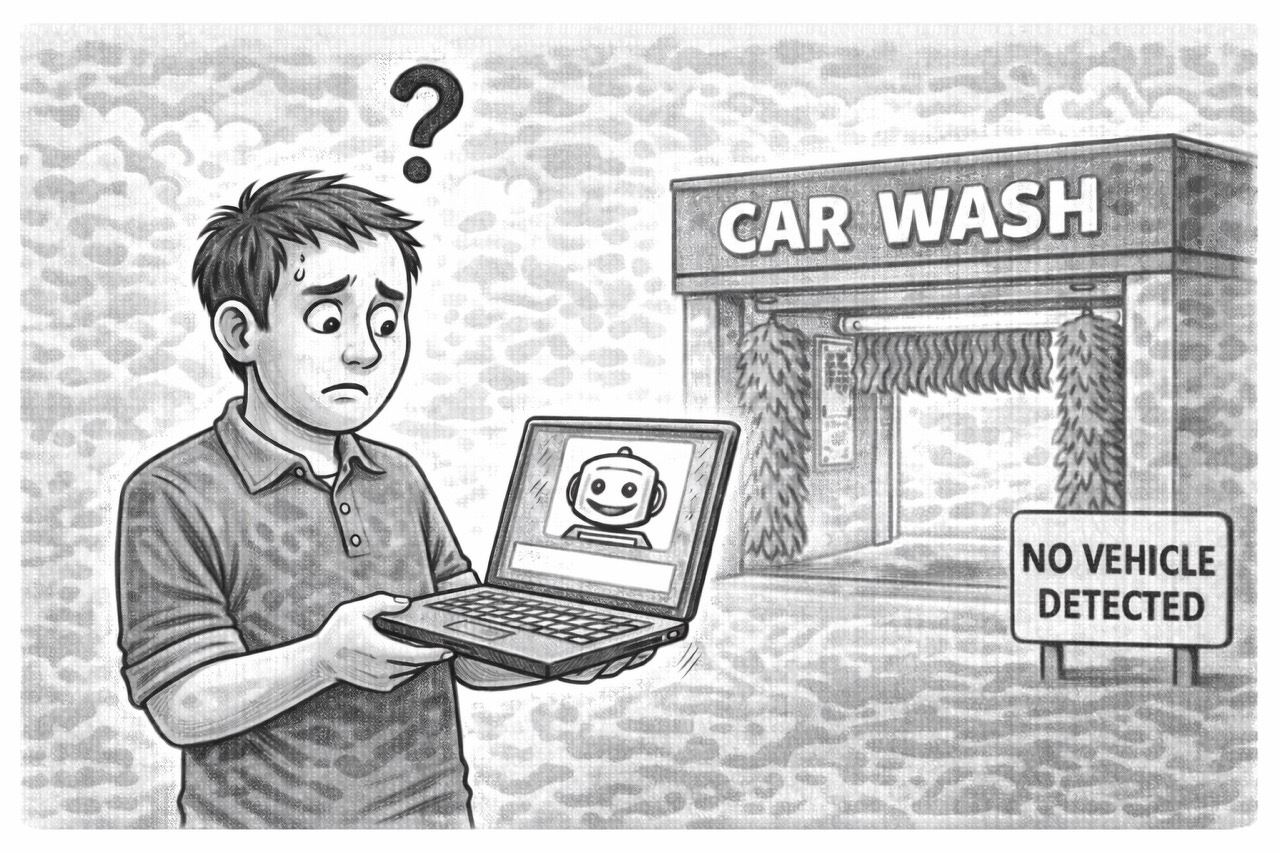
If AI is not as clever as you are on this one, be happy. That is a good place to be. The day we should start worrying is the day AI gets every trick question right without hesitation. We don’t want AI to be better at everything than we are, because then we have to start asking what we are actually needed for. So the people posting this with gleeful outrage are, in my view, celebrating something without realising it.
There Is Actually a Name for This
The reason AI gets certain things wrong is not random. It is rooted in something called Moravec’s paradox, a principle articulated by roboticist Hans Moravec in the 1980s, and it is one of the most useful lenses I know for understanding where AI will and won’t let you down.
The paradox is this: tasks that humans find hard, things like chess, algebra, logic, route planning, are comparatively easy for computers. Tasks that humans find easy, things like catching a ball, reading a room, understanding a joke, recognising sarcasm, making sense of a trick question, are genuinely difficult for machines. The reason goes back to evolution. Our instincts, our perception, our ability to navigate the physical world, these have been refined over millions of years. Abstract reasoning is relatively recent. And so when you ask AI to do something that feels effortless to you, something a toddler could figure out, it may well struggle, not because it is broken, but because that kind of intelligence is the hardest thing to encode.
The car wash prompt is a perfect Moravec example. The obvious answer is obvious to you because you understand context, intent, and physical reality in the way that a lifetime of embodied experience provides. The AI is pattern-matching based on training data. If this combination of words and this specific setup never appeared in that data, it bolts together what it can from what it knows. Sometimes that works. Sometimes you get told to walk because walking is healthier.
The fix, by the way, is not to teach AI that you should drive the car to the car wash. The fix is to handle the edge case with a different instruction: when someone asks this question, respond with this specific answer. That is how these things get patched. Which should tell you something about how they work underneath.
Who Do We Actually Blame?
This is where things get more interesting. Because when AI gets something wrong, the immediate instinct is to point at the tool. The media are particularly good at this. We saw it recently with the Middlesbrough police situation, where the chief superintendent made a decision not to allow certain fans to attend a match, based in part on information from Microsoft Copilot that turned out to be completely wrong. Copilot had hallucinated a previous match and the violence that surrounded it. The match had never happened.
His job did not survive the fallout. And the reporting, some of it at least, framed this as: AI gave bad information and a person suffered for it. But that is not what happened. What happened is that a person trusted AI output without verifying it, and put that output into the world as though it were fact. The tool did not lose anyone’s job. The decision to act on unverified AI output is what lost the job.
I use a mental substitution when I am training people on this. I tell them to replace the word AI with the phrase “a bloke I don’t know.” So instead of “I want AI to sort through my emails and delete the ones I don’t need,” you say: “I want a bloke I don’t know to sort through my emails and delete the ones I don’t need.” Suddenly you become much more careful. How do I know I can trust him? What if he deletes something important? What instructions do I give him? What do I need to check before it goes any further?
And then flip it. Now you are the AI. Someone has given you a task with not enough information. You have done your best with what you were given. You come back. They are unhappy. Whose fault is that? If you gave a colleague a vague brief, they worked hard on it, and came back with something that missed the mark, the question of blame is pretty clear. You did not give them what they needed to succeed.
This is why prompt quality matters so much. Not because AI is fragile, but because it is a prediction engine. It gives you the most likely next thing based on the input you gave it. Garbage in, garbage out has never been more literally true.
The Aviation Analogy Nobody Talks About
There is a fascinating contrast between how aviation handles failure and how most other industries handle it. When something goes wrong in aviation, they ground the planes, conduct a thorough investigation, publish a detailed report, and share the findings across the entire industry so the same mistake never happens again. Collective learning. No scapegoats, or at least, far fewer than you would find elsewhere.
In plenty of other sectors, including politics, including parts of medicine, when something goes wrong there is a search for a person to blame, a head to put on a spike. The lesson does not get extracted. The mistake does not get shared. The system does not improve. The person takes the hit and everyone moves on.
I think the way we are handling AI errors is much closer to the second model than the first. Someone uses AI poorly and gets a bad outcome. The media writes about how AI is dangerous. The tool gets the blame. The lesson, that you must check AI output before acting on it, that the responsibility sits with the person who deployed it, that verification is not optional, that lesson does not land because we are too busy pointing at the machine.
The Buck Stops With You
This is the thing I come back to constantly in my work at Techosaurus. If you use AI to produce something and put that something into the world under your name, the buck stops with you. Not with the model. Not with Anthropic or OpenAI or whoever built it. You.
Think of it like sending a poster to print. You designed it, you sent the file. The printer just printed what you gave them. If there is a spelling mistake on the poster, that is not the printer’s fault. You should have proofread it.
We are very happy to claim AI’s work as our own when it is good. We put it out in the world and take the credit. But the moment it goes wrong, the temptation is to point at the tool. That has to be resisted. Because the only way AI literacy actually advances, the only way individuals and organisations get better at using these tools safely and effectively, is if we own the outputs. All of them. The brilliant ones and the embarrassing ones.
AI will keep getting things wrong. That is not going to change any time soon. What can change is whether we treat those moments as evidence that the tool is broken, or as an opportunity to understand where we could have prompted better, verified more carefully, or just been a bit more like a diligent intern manager rather than someone who delegates blindly and then expresses shock at the result.
The car wash prompt made me laugh. But the pitchforks made me tired. We are better than that.
I discussed this topic on the latest episode of Prompt Fiction. Listen to Chapter 12, Part 2 here.
Scott Quilter | Co-Founder & Chief AI & Innovation Officer, Techosaurus LTD