Billions, Headlines, and the Boots-on-the-Ground Reality: A Practitioner's Take on the UK's £2.5 Billion AI and Quantum Bet
Today, Chancellor Rachel Reeves stood at the National Quantum Computing Centre in Oxford and declared the UK will achieve “the fastest AI adoption in the G7.” Paired with a record £2.5 billion investment spanning artificial intelligence and quantum computing, it is, on paper, the most ambitious tech commitment a UK government has ever made.
But there’s a problem with that ambition. We are investing heavily in infrastructure, while underinvesting in the people who actually have to use it.
As someone who spends every working week helping real businesses across the South West get to grips with AI, automation, and tech, I wanted to unpack what this actually means, where the genuine opportunity lies, and where I think the government still has a rather large blind spot.
The Headline Numbers
The package breaks down into two broad pillars. On the AI side, a £500 million Sovereign AI Fund is set to launch on 16 April at Wayve, the London-based self-driving vehicle company that itself secured over $1 billion from SoftBank, NVIDIA, and Microsoft back in 2024. The fund, chaired by James Wise of Balderton Capital, will give British AI companies access to funding, compute resources, and support to compete globally. Its core mission is to build domestic computing infrastructure and reduce our dependence on foreign cloud providers for sensitive data and intellectual property.
On the quantum side, a record £2 billion will upgrade the UK’s quantum capabilities, including a first-of-its-kind procurement programme worth up to £1 billion to develop and deploy commercial-scale quantum computers. Additional funding flows into the UK’s five National Quantum Research Hubs (£13.8 million), quantum sensing (£205 million), quantum networking (£125 million), and a new commercialisation skills centre (£12 million).
The Chancellor also used her Mais Lecture at Bayes Business School to set out three “big choices” for growth: AI and innovation, closer ties with Europe, and regional growth, including plans to hand more tax powers to regional mayors.
The Sovereignty Question: Who Actually Owns Our Digital Infrastructure?
The Sovereign AI Fund tackles something I’ve been talking about for a long time. When we say “AI” in business, what most people actually interact with are tools and platforms built by US companies. ChatGPT is OpenAI. Claude is Anthropic. Copilot is Microsoft. The cloud infrastructure underneath all of it overwhelmingly belongs to Amazon Web Services, Google Cloud, and Microsoft Azure.
That is a genuine strategic concern. UK businesses transmitting, processing, and storing sensitive data on infrastructure from overseas providers navigate complex legal frameworks around cross-border data flows. If geopolitical relationships shift (and recent months have shown how quickly that can happen), reliance on foreign infrastructure becomes a vulnerability, not just an inconvenience.
So the idea of building sovereign compute capacity, expanding facilities like Isambard-AI in Bristol and DAWN in Cambridge, and backing homegrown AI companies to stay and scale in the UK rather than being acquired overseas? That is sensible, long-term strategic thinking.
The UK has a painful track record here. DeepMind, one of the most important AI companies ever created, was founded in London in 2010 and acquired by Google for around $500 million in 2014. SwiftKey went to Microsoft. VocalIQ went to Apple. More recently, Bristol-based chip designer Graphcore was acquired by SoftBank. The pattern Reeves says she wants to end, of brilliant British companies “drifting abroad,” is very real.
Whether £500 million is enough to shift that pattern is another question entirely. For context, a single company like Mistral AI in Paris has raised over €2.7 billion in venture funding. The scale of capital available in the US dwarfs anything a UK government fund can offer. But providing compute access, data resources, and streamlined public sector procurement alongside the capital could make the UK a more attractive place for founders to stay. That is the detail worth watching.
Quantum: Exciting, But Not What Your Business Needs Right Now
This is where the government’s announcement gets muddier, and where I think bundling AI and quantum together does a disservice to both.
Quantum computing is exciting technology. Rather than processing problems methodically like a traditional computer, quantum systems can explore multiple potential solutions simultaneously. The applications in drug discovery, materials science, energy systems, and cryptography are potentially transformative. The UK has strong credentials here, having launched a national quantum programme back in 2014 and now being home to the second-highest number of quantum companies in the world.
But here is the critical thing: quantum computing is not AI, and it is not something your business is going to be using next Tuesday.
AI, as it stands today, is available to anyone with an internet connection. It can amplify the skills people already have, streamline admin, improve communications, accelerate research, and genuinely transform how small businesses operate. Quantum computing, by contrast, is bleeding-edge infrastructure technology that will primarily benefit researchers, scientists, and very large organisations solving very specific, computationally massive problems.
Lumping them together under one £2.5 billion headline creates the impression they are the same kind of opportunity. They are not. For the vast majority of UK businesses, particularly the SMEs that make up over 99% of the business population, AI adoption is the immediate, tangible opportunity. Quantum is the horizon. An important horizon, absolutely, but the horizon is still a long way off.
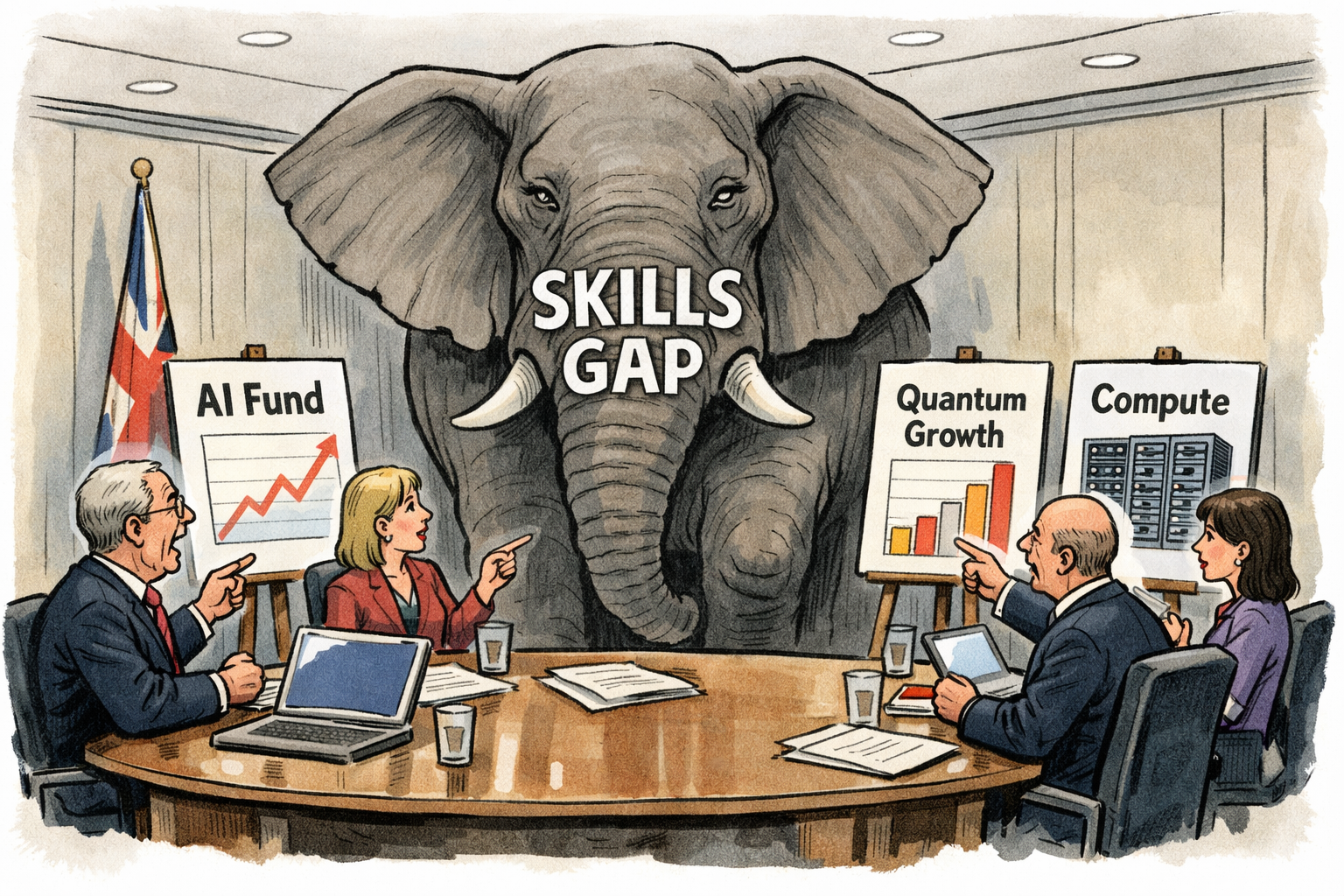
The Elephant in the Room: Who Is Actually Going to Use All This?
And here is where I get properly frustrated.
The government’s own research tells the story. Only 21% of UK workers feel confident using AI at work. Only one in six UK businesses were using AI in any meaningful way as of mid-2025. Micro businesses (those with fewer than ten employees) are 45% less likely to adopt AI than large businesses. A staggering 97% of organisations report at least one AI skills gap.
These are not small gaps. These are chasms. And you do not bridge chasms by launching a website.
You cannot win the AI adoption race if the people who are supposed to be running it have not been taught how to tie their shoes.
The government’s AI Skills Boost programme, which has delivered around one million course completions since June 2025, is a step in the right direction. The ambition to upskill 10 million workers by 2030 is admirable. But let us be honest about what “course completions” often means in practice: someone clicked through a 20-minute online module. A ‘course completion’ is not the same as competence. And it certainly isn’t adoption.
I have delivered over 2,000 hours of AI training to more than 150 businesses through Skills Bootcamps and direct training programmes. Here is what I can tell you from that experience: people need their hands held. They need to sit with a trainer, try things in their own context, make mistakes, ask questions, and build confidence over time. The idea that we can upskill a nation through self-directed online portals fundamentally misunderstands how adults learn, particularly when the subject matter feels alien and intimidating.
AI is not a technology skill. It is a communication and delegation skill. It is a life skill. It is a language skill. Getting businesses to understand that, and then to feel comfortable acting on it, requires human-led, in-person (or at least live, interactive) training. It requires funded programmes that are accessible, not just available.
Last month, I worked with a small manufacturer spending three hours a week on manual reporting. Within an hour, we had it automated using tools they already had.
Which brings me to a rather pointed irony. While the government announces billions for sovereign AI funds and quantum procurement, the funding for the very Skills Bootcamp programmes that are actually putting trainers in rooms with real businesses has been cut. Somerset’s Skills Bootcamp allocation saw roughly a 68% reduction. The programmes that are doing the boots-on-the-ground work of AI adoption are being defunded while the headline investment goes to infrastructure and frontier technology.
Where the Money Should Go
If the government is serious about the fastest AI adoption in the G7, here is what I would want to see alongside the infrastructure investment:
Ring-fenced funding for SME training delivery. Not online portals. Not 20-minute modules. If the barrier is confidence and context, funding must go to in-person, facilitated SME training delivery.
Distribute the Sovereign AI Fund widely. The big tech players are already doing what they do. If we want genuine sovereignty and a competitive ecosystem, the money needs to reach smaller, innovative companies that can disrupt the market, not just consolidate it.
Separate the AI and quantum narratives. They are different technologies, with different timelines, different audiences, and different implications. Conflating them confuses businesses and dilutes the urgency of the AI adoption message.
Measure adoption, not awareness. Course completions are not the same as business transformation. We need metrics that reflect genuine behaviour change: are businesses actually using AI tools? Are they saving time? Are they making better decisions? Are their employees more confident?
Invest in the educators. Behind every successful AI adoption story is someone who helped a business get there. Train the trainers. Fund the colleges, the independent providers, the community-based programmes that are reaching people where they are.
The Opportunity Is Real. The Delivery Must Match It.
The fact that the UK government is investing £2.5 billion in AI and quantum, is talking seriously about sovereignty and infrastructure, and is aiming for G7 leadership in AI adoption: all of that is genuinely welcome. The ambition is right. The direction is right.
But ambition without delivery is just a speech. And delivery, when it comes to AI adoption, does not happen in Oxford research centres or Whitehall strategy documents. It happens in offices in Yeovil, workshops in Taunton, and training rooms in Somerton. It happens when a sole trader discovers that AI can help them write better proposals. It happens when a manufacturer realises they can automate a reporting process that was eating three hours a week. It happens one person, one business, one skill at a time.
That is where the race is actually won. I hope the government starts running it there, too.
Scott Quilter FBCS is Co-Founder and Chief AI & Innovation Officer at Techosaurus LTD, an award-winning EdTech company delivering AI and automation training across the South West. He lectures at Yeovil College, sits on the Digital Somerset board, and co-hosts the Prompt Fiction podcast. His views are informed by over 2,000 hours of direct AI training delivery to 150+ businesses.
Have thoughts on today’s announcement? Find Scott on LinkedIn or visit techosaurus.co.uk