OpenAI Quit Its Side Quests and That Might Save Them
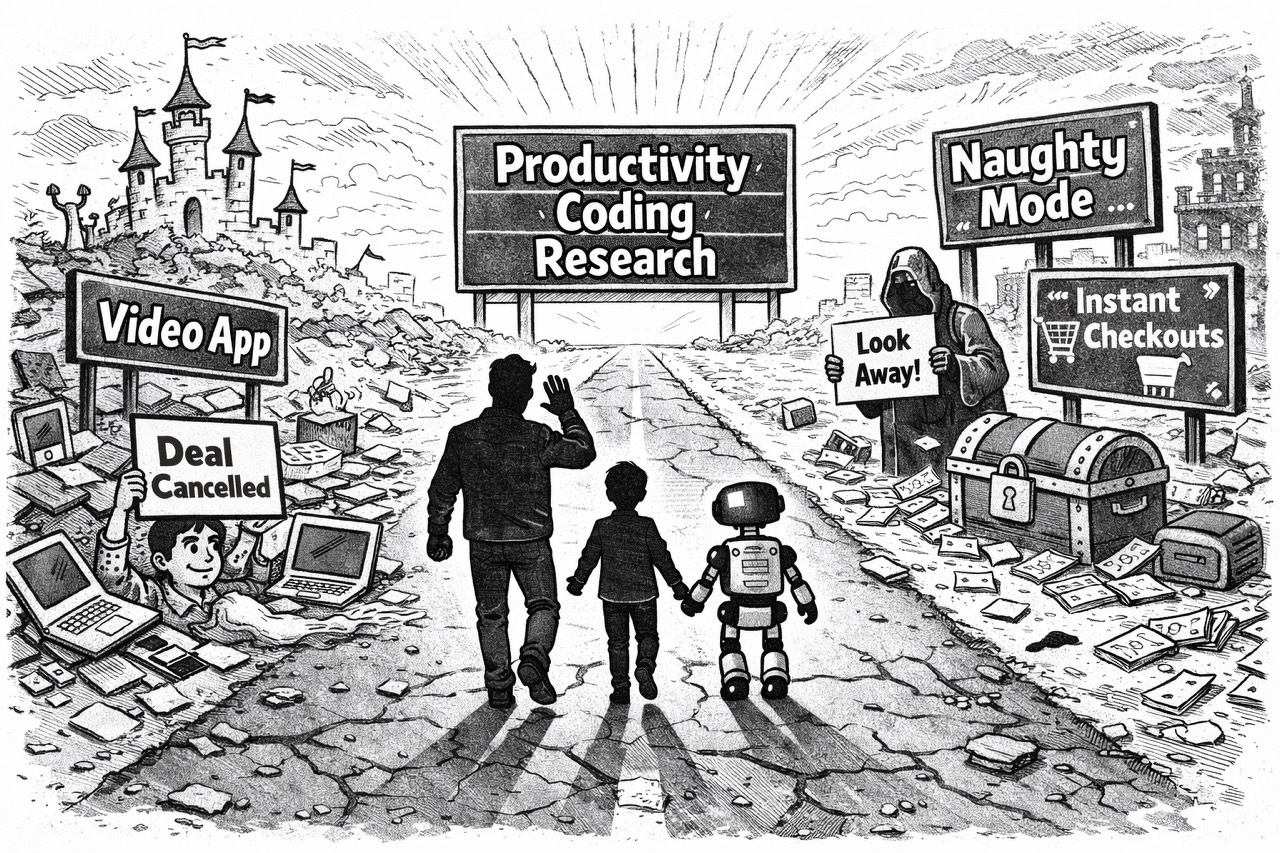
On 24 March, OpenAI did something I genuinely didn’t expect. They announced they’re shutting down Sora, the AI video generation app that launched to enormous fanfare just six months earlier. The Disney deal that was supposed to bring Mickey Mouse and Cinderella to AI-generated video? Dead. The $1 billion Disney investment in OpenAI that came with it? Off the table. The standalone app that hit number one in the App Store within a day of launch? Gone.
And then, almost as a footnote, they confirmed that “naughty mode,” the uncensored personality option that made a lot of people uncomfortable, has been shelved indefinitely.
This isn’t a company in crisis. This is a company that’s finally being honest with itself about what it should be doing.
What Actually Happened with Sora
The Wall Street Journal dug into the numbers behind the shutdown, and the picture is brutal. Sora’s user count peaked at about a million shortly after launch and then collapsed to fewer than 500,000. Meanwhile, the app was burning through roughly $1 million every single day. Video generation is horrendously expensive to run. Every user who dropped themselves into a fantastical scene was drawing down a finite supply of AI chips.
OpenAI framed it as a strategic choice. “As we focus and compute demand grows, the Sora research team continues to focus on world simulation research to advance robotics that will help people solve real-world, physical tasks,” a spokesperson said. Translated from corporate: we’re taking the GPU power that was making funny videos and pointing it at things that actually make money.
The Disney partnership was meant to be transformative. A three-year licensing agreement that would have let users generate videos with over 200 Disney, Marvel, Pixar, and Star Wars characters. Disney was going to take a $1 billion stake in OpenAI as part of the deal. All of that is now unwound. A Disney spokesperson was diplomatic about it, saying they “respect OpenAI’s decision to exit the video generation business.”
The copyright issues were mounting, too. Japanese content trade group CODA, whose members include Studio Ghibli, had demanded OpenAI stop using their content to train Sora. Deepfake concerns were constant. And the Sora team themselves had admitted their GPUs were “melting” under the strain.
Sources: CNN (24 Mar 2026), TechCrunch (29 Mar 2026), CNBC (24 Mar 2026), Variety (24 Mar 2026)
Naughty Mode Is Gone Too
We talked about this on the podcast a couple of episodes ago, and we were both uncomfortable with it. The idea of an “uncensored” personality mode in the world’s most popular chatbot felt like a solution to a problem nobody sensible was asking to solve. The same team that has now said “quit the side quests” confirmed that naughty mode has been shelved indefinitely.
Good. If you want unrestricted AI output, there are tools for that. The world’s most visible AI product, the one that most people think of when they hear the letters A and I, should not be the one pushing that boundary. Especially not when the same company is simultaneously trying to position itself as a serious enterprise and government partner.
The Real Story: OpenAI Is Copying Claude’s Playbook
Here’s what I think is actually going on. While OpenAI was spreading itself across video generation, voice personalities, image editing, shopping features, and every other shiny idea that crossed someone’s desk, Anthropic was doing the opposite. Claude doesn’t generate images. It doesn’t make videos. It doesn’t do voice particularly well (yet). What it does is think, write, code, and reason, and it does those things exceptionally well.
And people noticed. Claude hit number one on the US App Store. The #QuitGPT movement pulled millions of users across. Anthropic’s focus on doing fewer things brilliantly, while maintaining safety standards that cost them a $200 million government contract, turned out to be the most effective marketing campaign in AI history.
OpenAI’s pivot towards focus is a direct response to that. They’re combining their web browser, ChatGPT app, and Codex coding app into one desktop super app. They’re concentrating compute on the things that drive revenue: coding, reasoning, enterprise productivity, and text generation. That’s not retreat. That’s recognition that in AI, depth beats breadth.
What This Means for the Rest of Us
For anyone watching this space from a business perspective, the lesson is clear. The AI tools that are going to matter in the long run are not the ones that try to do everything. They’re the ones that do the things you actually need, reliably and well.
Sora was a spectacle. It was fun, it was impressive, and it generated some genuinely jaw-dropping clips. But it wasn’t useful. Not in the way that having an AI that can draft your contracts, analyse your data, or help you build a website is useful. The compute power that was making those 30-second videos is now going to go towards making ChatGPT better at the stuff that actually matters to the people paying $20 a month for it.
If there’s a takeaway here, it’s this: when someone shows you a shiny AI demo, the question worth asking isn’t “that’s cool, what else can it do?” It’s “is this actually solving a problem I have?” Because the companies that survive the next few years of AI competition will be the ones that answered that question honestly. OpenAI just started.
I discussed this topic on the latest episode of Prompt Fiction. Listen to Chapter 13, Part 1 here.
Scott Quilter | Co-Founder & Chief AI & Innovation Officer, Techosaurus LTD