FOBO Is Not Your Identity. It’s Your Wake-Up Call.
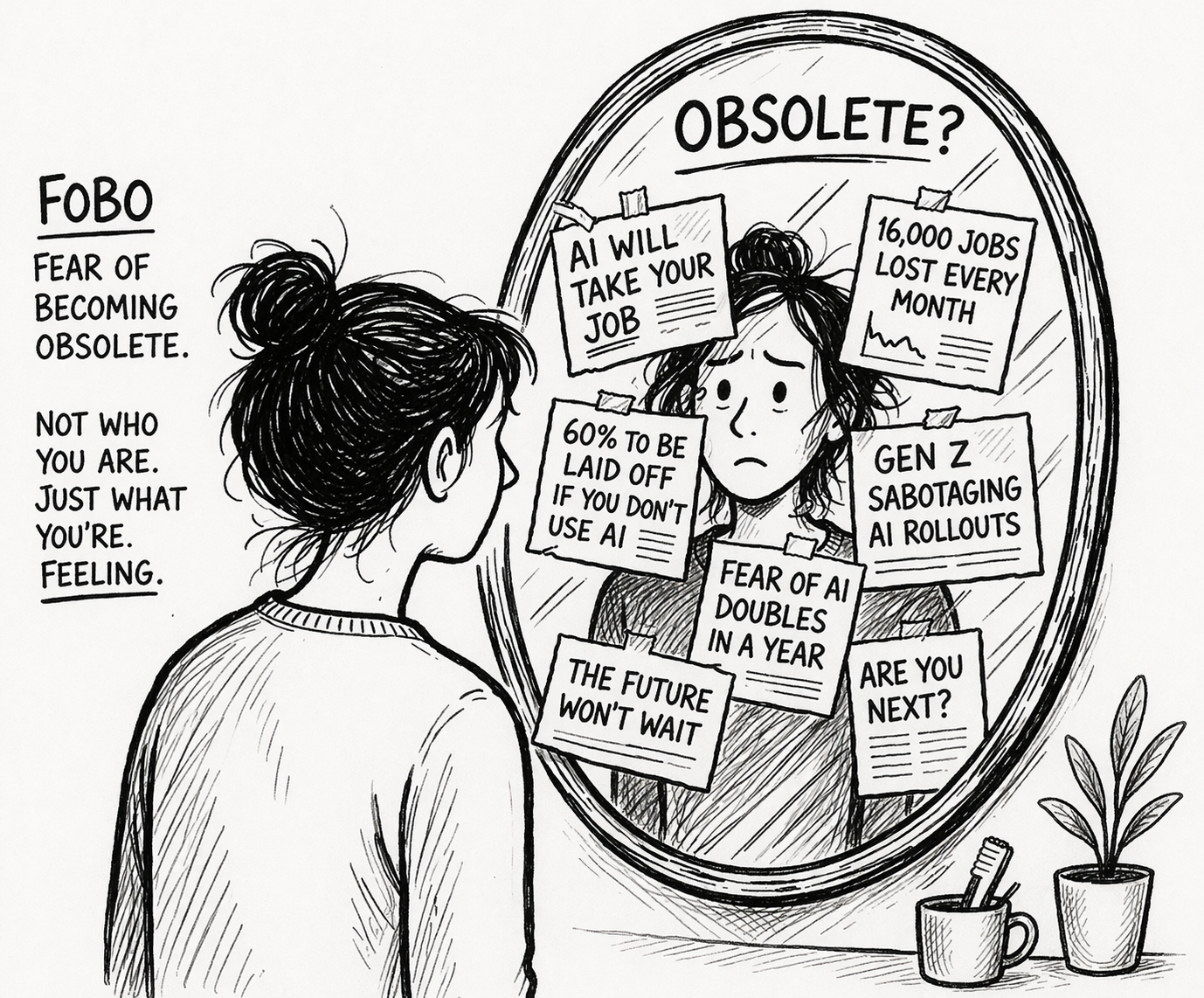
There’s a new acronym doing the rounds, and I think it’s one of the most important words in the AI conversation right now. FOBO. Fear Of Becoming Obsolete. Not the fear of being fired. The fear of becoming irrelevant. Of waking up one day and realising the world moved on without you.
If you’ve felt that, even a flicker of it, I want you to know two things. First: you are not alone. Second: FOBO is something you’re experiencing, not something you are. And that distinction matters more than you might think.
The Headlines Are Doing the Heavy Lifting
This week, a Writer and Workplace Intelligence survey of 2,400 workers and executives across the US, UK, and Europe found that 29% of employees admit to actively sabotaging their company’s AI strategy. Among Gen Z, that number jumps to 44%. The methods range from feeding company data into unapproved public tools, to outright refusing to use AI, to deliberately producing poor work to make AI look bad. Of those who admitted to sabotage, 30% said they did it because they feared losing their job.
Meanwhile, Goldman Sachs published research estimating that AI is already erasing roughly 16,000 net jobs per month in the US, with the impact falling hardest on entry-level workers and Gen Z. And KPMG’s American Worker Survey from late 2025 found that fear of AI-driven job displacement had nearly doubled in a single year, with 52% of workers now expressing concern.
Those are real numbers from serious organisations. I’m not dismissing them. But here’s what I want you to notice: by the time those numbers reach you, they’ve already been through the headline machine. “60% of companies plan to lay off employees who won’t adopt AI.” That’s the headline. And most people won’t read past it.
What they won’t read is that the same survey found 75% of executives admit their company’s AI strategy is “more for show” than actual internal guidance. Or that 48% of those same leaders described their own AI adoption as a “massive disappointment.” Or that fewer than 19% of US businesses have actually adopted AI at all, according to Goldman Sachs’ own AI Adoption Tracker.
The fear is real. But the picture being painted is incomplete. And incomplete pictures, told loudly enough, become the whole story.
The Irony Nobody Is Talking About
Here’s what gets me. The very tool that people are afraid of is the one that could help them make sense of what’s actually happening.
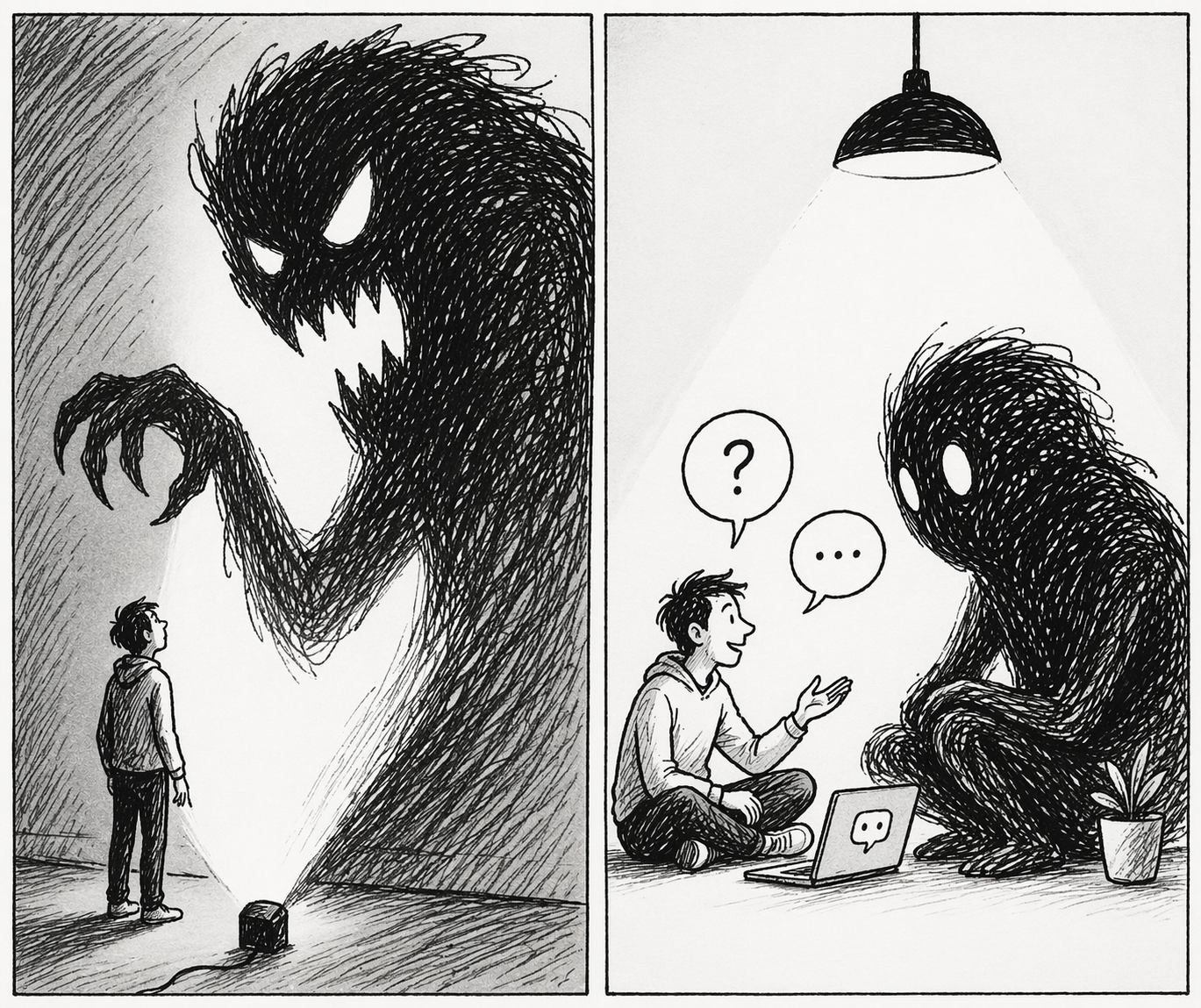
If you read a headline that says “AI is cutting 16,000 jobs a month” and it makes your stomach drop, you could open ChatGPT, or Claude, or Gemini, and type: “I just read that AI is cutting 16,000 jobs a month. I work in [your field]. Can you help me understand what this actually means for someone like me? What should I be thinking about?”
That’s not a technical prompt. That’s a conversation. And the answer you’d get would be more nuanced, more personalised, and more useful than any headline. It would help you understand where your skills sit, what’s changing in your sector, and what you could do about it. The cure for FOBO, ironically, is the thing that’s causing it.
The C-Suite Has a Lot to Answer For
Let’s talk about the other side of this. Because FOBO isn’t just appearing out of thin air. It’s being manufactured, partly by sensationalist reporting, and partly by leadership that doesn’t know what it’s doing yet but can’t afford to look like it.
The Writer survey found that 92% of C-suite executives say they’re actively cultivating a new class of “AI elite” employees. That 60% plan to lay off those who won’t adopt AI. That 77% say employees who refuse to become AI-proficient won’t be considered for promotions.
Now hold those numbers against this: 79% of those same executives admit they’re struggling with lagging ROI, strategy gaps, and internal power struggles around AI. Only 29% have seen significant return on investment from generative AI. And 75% say their AI strategy is performative.
So we’ve got executives threatening to cut people who don’t use AI, while most of them don’t have a real plan for how AI fits into their business. That’s not strategy. That’s dressing up cost-cutting as transformation. And the people on the ground can smell it.
Businesses absolutely have the right to expect their teams to engage with new tools. If your company has invested in AI, trained you on it, and you’re refusing to use it, that’s a conversation worth having. But the responsibility runs both ways. If you’re going to tell people their jobs depend on using AI, you’d better have given them the training, the support, and the clarity to do it well. Most haven’t. The KPMG survey found that while 85% of companies offer some form of AI training, 84% of employees say they need more of it. And fewer than half make that training mandatory.
You can’t threaten people for not using something you haven’t properly equipped them to use. That’s not a technology failure. That’s a leadership failure.
Gen Z Isn’t the Problem. They Might Be the Bridge.
The easy narrative is that Gen Z are scared, they’re sabotaging, they’re the problem. I don’t buy it.
Yes, 44% of Gen Z workers admitted to sabotaging AI rollouts. That number looks bad on its own. But Gen Z are also the most connected, most digitally literate generation we’ve ever had. They’re the cohort most likely to be building side projects with AI, most likely to be using these tools outside of work, and, according to Goldman Sachs’ separate analysis of 40 years of displacement data, the group best positioned to recover from technological disruption because they adapt faster and reskill more readily than older workers.
Gen Z don’t just need different tools. They need different management. They expect transparency. They expect legitimacy. They are far more willing than previous generations to push back when something doesn’t feel right. And when a company says “use AI or lose your job” while simultaneously having no coherent AI strategy, that doesn’t feel right. The sabotage isn’t random. It’s a signal.
What Gen Z actually needs is proper support, honest leadership, and the chance to use their natural adaptability in a way that helps the whole organisation. They could be the generation that lifts everyone else up, the ones who help their 45-year-old managers get comfortable with the tools. But only if leadership creates the conditions for that to happen. That means better coaching, better management, and a genuinely evolved approach to how we develop people.
This Isn’t New. It’s Just Louder.
None of this is unprecedented. We had the same fear when the internet arrived. We had it when email replaced letters. We had it when ATMs replaced bank tellers (and then we got more bank tellers, because the cost savings let banks open more branches). Every wave of technology brings a wave of fear, and every time, the people who engage with the change early are the ones who do best.
The difference this time is volume. We live in a world where a single survey stat can become a global headline within hours. Where fear travels faster than context. Where algorithms reward panic over nuance. The FOBO isn’t more real than it was in 1995 when people thought the internet would end human interaction. It just feels more real because everything is louder.
If You’re Reading This and You Feel It
If FOBO is something you’re carrying around right now, here’s what I’d say.
FOBO is a diagnosis, not an identity. It’s telling you something. It’s telling you that the world around you is changing and you’re not sure where you fit yet. That’s a completely reasonable thing to feel. But the worst thing you can do with that feeling is freeze, or fight the change, or pretend it isn’t happening.
The SAP and Wakefield Research study published this week found that 88% of HR leaders say AI is making early-career workers productive faster, not replacing them. Entry-level roles are evolving, not vanishing. The Goldman Sachs research, for all the scary headlines it generated, also found that the true aggregate impact of AI on jobs is likely smaller than the estimates suggest, because the offsetting hiring surge in AI infrastructure isn’t fully captured yet.
The water is rising. But you have time to move. And the single best thing you can do right now is start using the tools. Not because your boss told you to. Not because a headline scared you. Because curiosity is the antidote to fear, and the people who stay curious are the ones who stay relevant.
Open an AI tool. Tell it what you’re worried about. Ask it to help you understand your own situation. Have a conversation with it. That one act, using the thing you’re afraid of to explore the fear itself, is the most powerful first step you can take.
The future doesn’t belong to the people who know the most about AI. It belongs to the curious. It always has.
Scott Quilter | Co-Founder & Chief AI & Innovation Officer, Techosaurus LTD