The AI Confidence Crisis: What the 2026 Global Talent Barometer Reveals About the Modern Workplace
Here at Techosaurus, we make it our business to read, distil, and share the reports that matter. The ManpowerGroup Global Talent Barometer 2026 is one such report, and it paints a fascinating picture of where we are right now in the world of work.
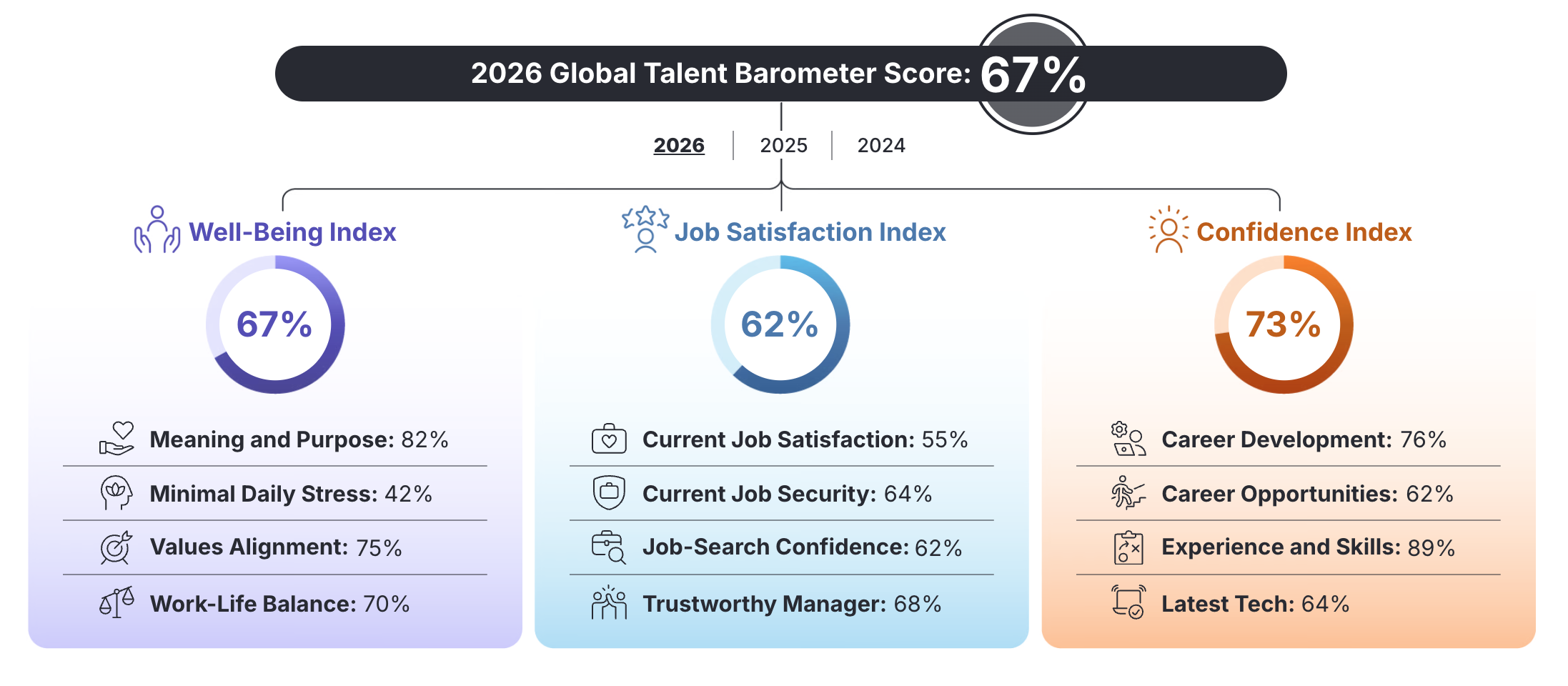
Nearly 14,000 workers across 19 countries were asked about their well-being, job satisfaction, and confidence. The findings are both illuminating and, in places, concerning.
An important note before we continue: This is not an AI report. This is not a technology report. ManpowerGroup conducted this research purely to understand the workforce. We’ve chosen to focus on the AI and training elements because that’s our area of expertise, but there is so much more in this report covering well-being, job satisfaction, generational differences, gender dynamics, and industry-specific insights. We’d strongly encourage you to read it in full.
The global picture
Before we dive into the AI-specific findings, a few headline observations stand out. India leads the world in worker sentiment at 77%, whilst Japan sits at the bottom with just 48%. The UK comes in at 69%, placing us comfortably above the global average of 67%. These differences reflect not just economic conditions but cultural attitudes towards work, technology adoption, and employer-employee relationships.
AI adoption is surging, but confidence is plummeting
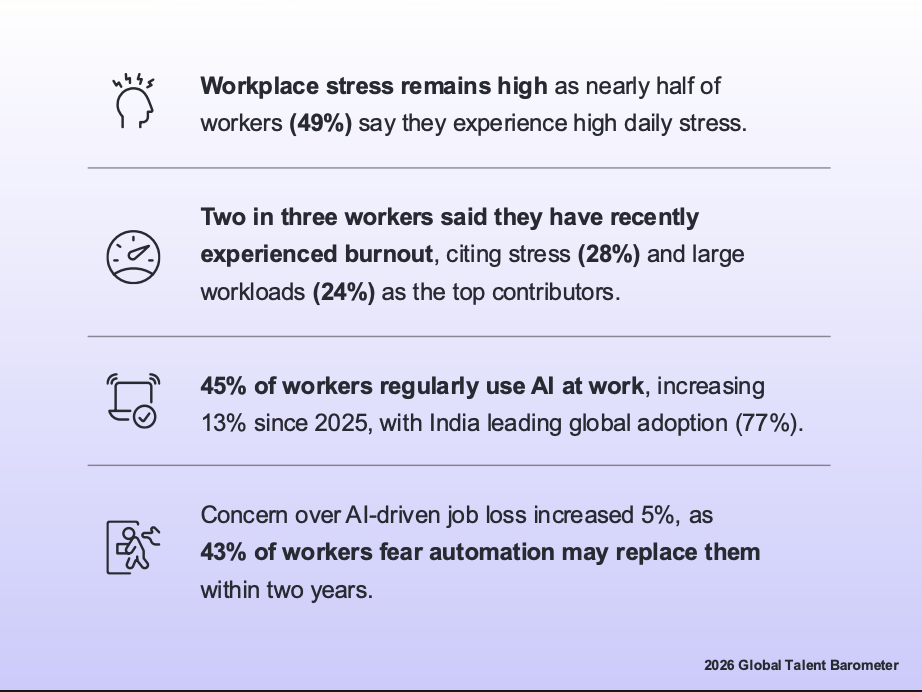
Here’s where things get really interesting. AI usage in the workplace has jumped 13% in the past year, with 45% of workers now regularly using AI tools. That’s nearly half the global workforce engaging with these technologies daily.
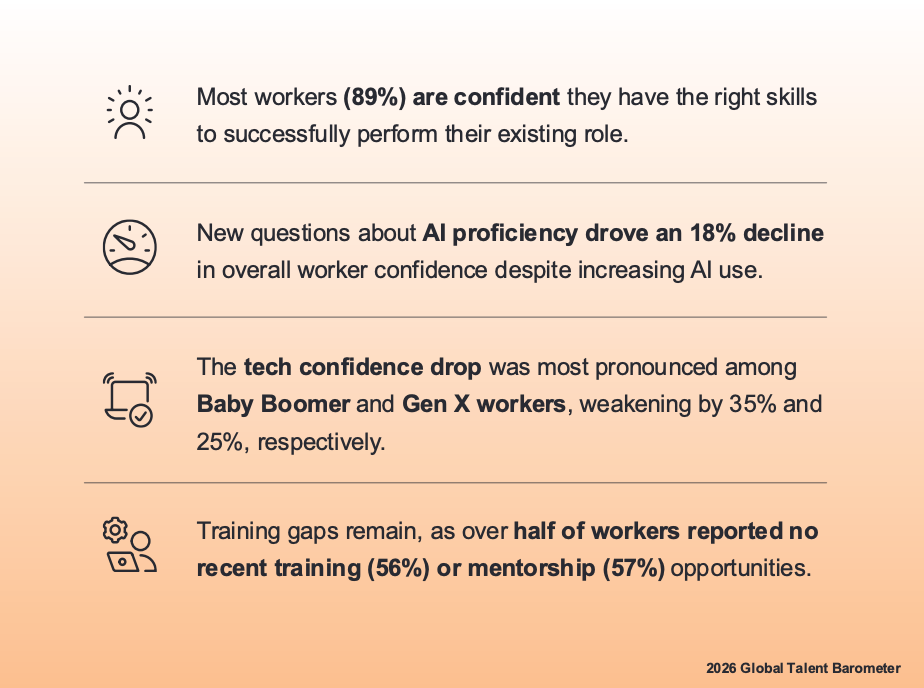
Yet here’s the paradox: whilst more people are using AI, their confidence in doing so has fallen by 18%. How can that be?
The answer lies in enablement, or rather the lack of it. Organisations are rolling out AI tools without the training and support needed to use them effectively. When you give someone a tool that can touch every aspect of their work but provide no guidance on how to use it properly, you create anxiety rather than empowerment.
The training gap is stark
The numbers tell the story clearly. Over half of workers (56%) reported receiving no training in the past six months to a year. A similar proportion (57%) have had no mentorship during the same period. This isn’t a minor oversight; it’s a systematic failure to prepare people for the tools they’re being asked to use.
The confidence drop is most pronounced among older workers. Baby Boomers (born 1946–1964, currently aged 61–79) have seen their tech confidence fall by 35%, whilst Gen X workers (born 1965–1980, currently aged 45–60) experienced a 25% decline. These are experienced professionals with valuable institutional knowledge, often in senior positions with decades of expertise, and we’re leaving them behind.
From job-hopping to job-hugging
The economic uncertainty of recent years has changed behaviour patterns. Where we once saw AI skills enabling people to move between roles and organisations, we’re now seeing what the report calls “job hugging”. Workers are staying put, clinging to the security of their current positions.
But here’s the thing: 64% plan to stay with their current employer, yet 60% are actively looking for other opportunities. That’s not loyalty; that’s hedging bets. People are holding on whilst keeping their options open, and 43% fear automation may replace them within two years.
The confidence hierarchy
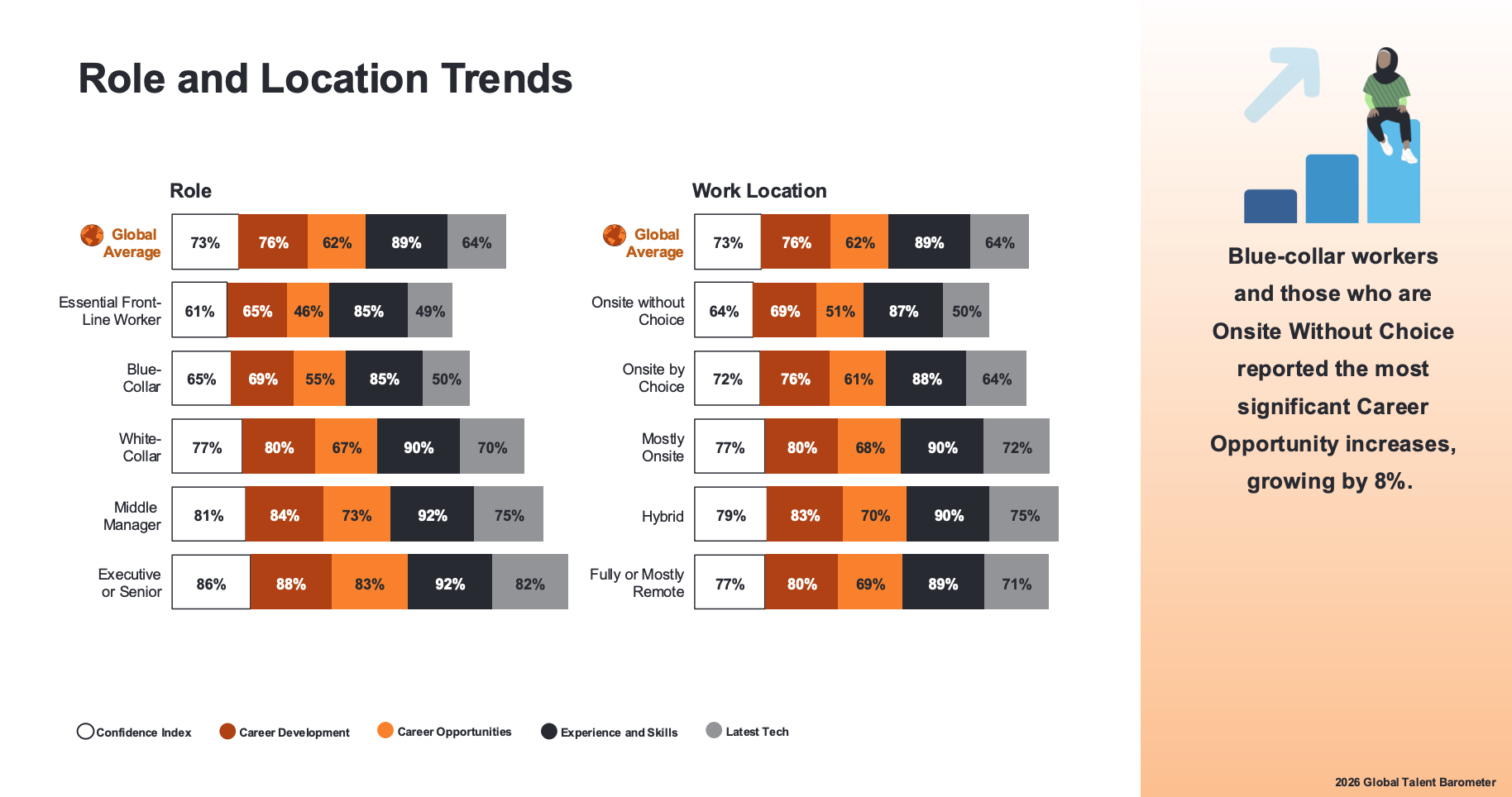
One of the most revealing aspects of the report is how confidence varies by seniority. Essential and frontline workers show considerably lower confidence in their job role, their abilities, and their prospects for advancement. This confidence increases steadily as you move up the organisational hierarchy, with executives and senior leaders feeling far more secure.
This pattern tells us something important. The people closest to the operational reality of work, those on the front lines, are the ones feeling most uncertain. If we want to address this, we need to invest more time in these workers. We need to provide more training, more support, and more attention to their development.
Location matters more than you might think
The report also reveals interesting dynamics around work location. Workers who are on-site without choice, those told they must be in the office with no flexibility, show considerably lower confidence than their counterparts who work hybrid or remotely.
Hybrid workers, those given the freedom to choose where they work, report much higher satisfaction across multiple measures, including their own career development. This isn’t about remote work being universally better; it’s about autonomy. When people feel trusted to manage their own working arrangements, they feel more confident about their future.
The burnout backdrop
All of this plays out against persistently high levels of workplace stress. Nearly half of workers (49%) report high daily stress, and 63% say they’re currently experiencing burnout. The top contributors? Stress itself (28%) and overwhelming workloads (24%).
You cannot ask people to embrace new technologies, adapt to changing work patterns, and navigate uncertainty whilst simultaneously burning them out. Well-being and capability development must go hand in hand.
What good looks like: A case study in doing it right
Reading reports like this can feel overwhelming. Where do you even start? So let me share an example of an organisation getting it absolutely right.
We’re currently working with a large, well-established legal firm with over 350 employees. They’ve had an AI Council in place for the past year, methodically investigating how AI works, how it could benefit their business, and how it’s reshaping their industry landscape. They approached us to help with their policies and training programme.
What makes their approach exceptional is their understanding that AI training is not a one-and-done, box-ticking exercise. It requires protected time, genuine investment in people’s skills, clear communication, internal champions, and a network of learners who grow together.
Here’s how they’ve structured it:
Phase one: Foundation building. CPD videos and introductory content help everyone understand what AI tools are, what they do, how they work, where they come from, what they’re excellent at, and crucially, what they’re not good at. This covers the fundamentals before anyone touches a tool in anger.
Phase two: Crawl, walk, run. We apply our crawl-walk-run methodology throughout. You need to understand something and use it simply before you can use it in complex ways. That might mean using AI in day-to-day life before applying it to business contexts. Even within business use, you’ll work on indirect tasks long before considering direct tasks, if you use it for direct tasks at all.
Phase three: Hands-on learning. Following the online foundations, we deliver in-person training that’s practical and experiential. People are encouraged to experiment, learn, and communicate with each other about what they’re discovering.
Phase four: Ongoing support. They’ve created an online platform for FAQs and questions where people receive responses and support. Champions are nominated from within the team, given access to additional features and licenses, whilst the business listens to their feedback. What’s working? What isn’t? What ideas are emerging from the people actually using these tools?
Phase five: Continuous evolution. This is a tool that constantly changes, with applications across every function of a business. Once champions reach a certain level of proficiency, they receive further bespoke training, mentoring, and coaching tailored to their specific roles and the ideas they’re developing.
There’s another crucial element to their approach: they understand that AI training shouldn’t be delivered solely by technologists. AI is so much more than a tech tool. You need people proficient in using AI within HR to train HR teams. You need people experienced in AI for sales to train salespeople. Asking IT departments to train functions they have no experience in is unrealistic and simply doesn’t work.
This approach also recognises that AI has become a gateway to automation, something that’s existed for decades but was historically ringfenced by technical departments. Now, people across the business can bring ideas to the table that genuinely drive growth and success.
What this means for organisations
The message from this report is clear. Simply deploying AI tools is not an innovation strategy. Without parallel investment in training, support, and enablement, organisations risk creating a workforce equipped with powerful tools they neither trust nor understand.
The opportunity for forward-thinking organisations is significant. Those who actively bridge the skills gap, provide meaningful development opportunities, and address burnout can differentiate themselves in the talent market. In a world of job-huggers waiting for someone to show them the way forward, being that guide is a competitive advantage.
The bottom line
The 2026 Global Talent Barometer reveals a workforce caught between two worlds: confident in their current abilities but anxious about what comes next. AI is reshaping work faster than most organisations are preparing their people for it.
For anyone wanting to know the right way to do this, to increase job satisfaction, to improve well-being, to build confidence, and to create a business where employees feel invested in and aren’t constantly looking elsewhere, the answer is straightforward: give your people access to the tools that will make their jobs more rewarding. Enable them to achieve more than they ever thought possible. Believe in them. Invest in them. Nurture them. That’s what leadership looks like.
The report backs up everything we say. Have a read.
The full ManpowerGroup Global Talent Barometer 2026 is available to download from their website.