AI is a business skill now, but the human part still matters.
On Friday 12 June 2026, I delivered a keynote at the Somerset Business Expo, hosted by Sedgemoor Chamber of Commerce at The Venue @ Junction 24, M5, Bridgwater.
The room was full of the kind of people I like speaking to most: business owners, local leaders, people trying to grow something, people trying to make sense of what technology now means for their work.
And AI came up, obviously.
The bit I wanted to get across was simple. AI can get you a long way, very quickly. But if you ask it to do something, copy the answer, and put it straight out into the world, you’ve skipped the bit where your judgement, values, context, and taste are supposed to go.
At that point, you’re just operating the machine.
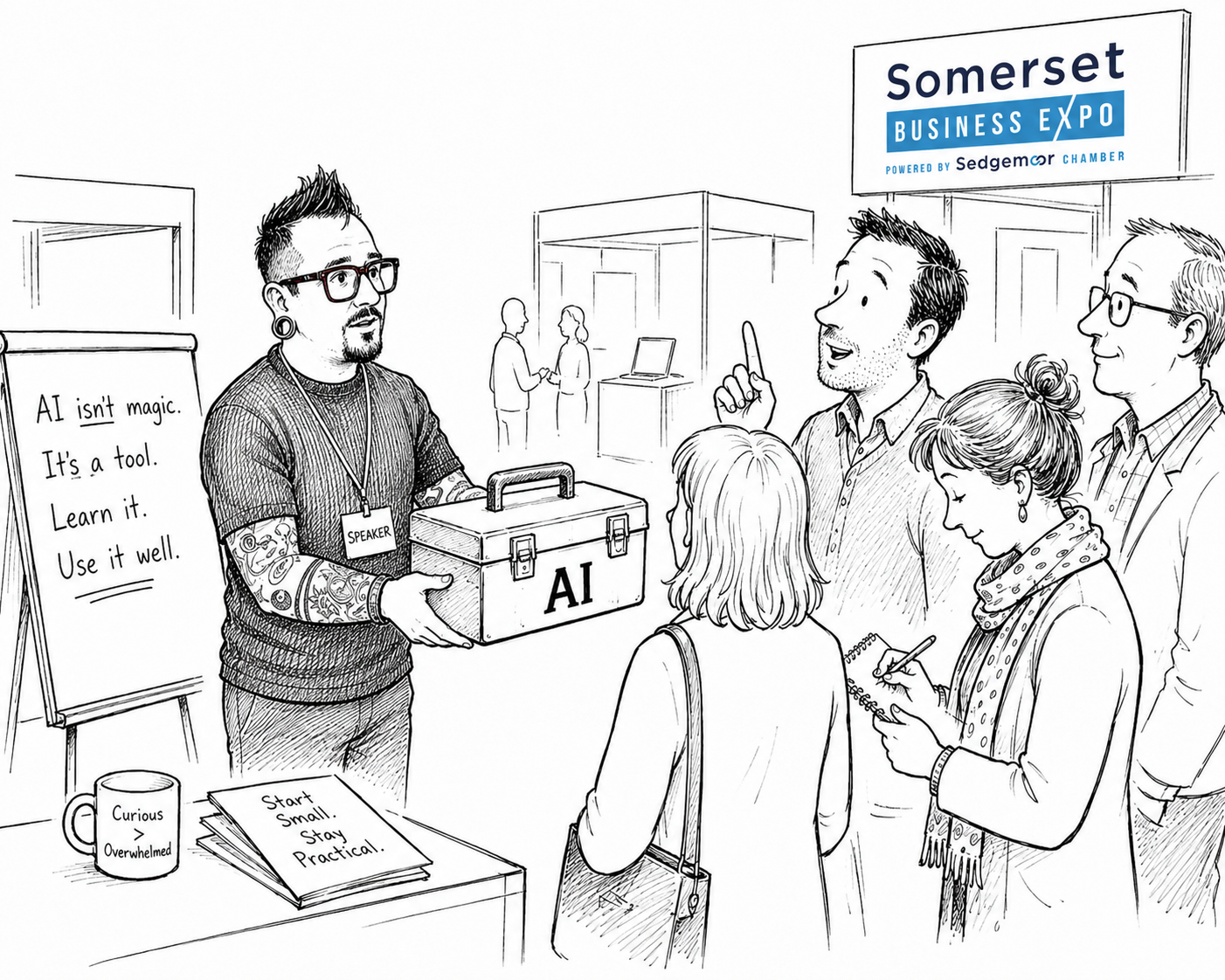
The Expo had the right energy for this conversation
The Somerset Business Expo is a full day built around Somerset enterprise and practical business growth.
This year, the event moved to a larger venue at Junction 24 near Bridgwater, with room for more than 70 exhibition stands. That mattered, because the day felt properly county-wide. Exhibition floor, workshops, local talks, speed connecting, free business support, and a lot of conversations between people who probably should have met each other years ago.
That’s a good setting for an AI talk.
Because AI adoption can sound abstract when it’s discussed online. In a room full of real businesses, it becomes much more grounded. People don’t ask, “How do I participate in the future of work?” They ask things like:
How do I save time after a meeting?
How do I write better notes?
How do I stop my team using random tools with company information?
How do I get started without feeling daft?
Those are better questions.
We need to move past “write me a prompt”
Most people start with prompts. That’s fine. You open ChatGPT, Copilot, Claude, Gemini, or whatever tool you’re using, and you talk to it.
A prompt is a one-off instruction.
That might be: “Help me write this email.” Or “Summarise these notes.” Or “Explain this in plain English.”
That’s where most people begin, and it’s where they should begin. Crawl, walk, run. I’m not handing someone a chainsaw and calling them a tree surgeon.
But prompts are only the first step.
The next step is agents. An agent is like inviting a specialist into the business. Instead of warming up a general AI every time, the agent already knows its role. It knows what sort of task it is there to help with.
Then you get to skills.
A skill is a saved way of doing something. It’s a reusable method.
If I teach AI how Techosaurus writes meeting notes, what sections we need, what format we use, what to ask when something is missing, and how the Word document should look, that can become a skill.
Then, next time, I don’t have to explain it all again. The AI recognises the task and uses the method it has been taught.
That’s when it starts to feel less like a clever chat box and more like a practical business tool.
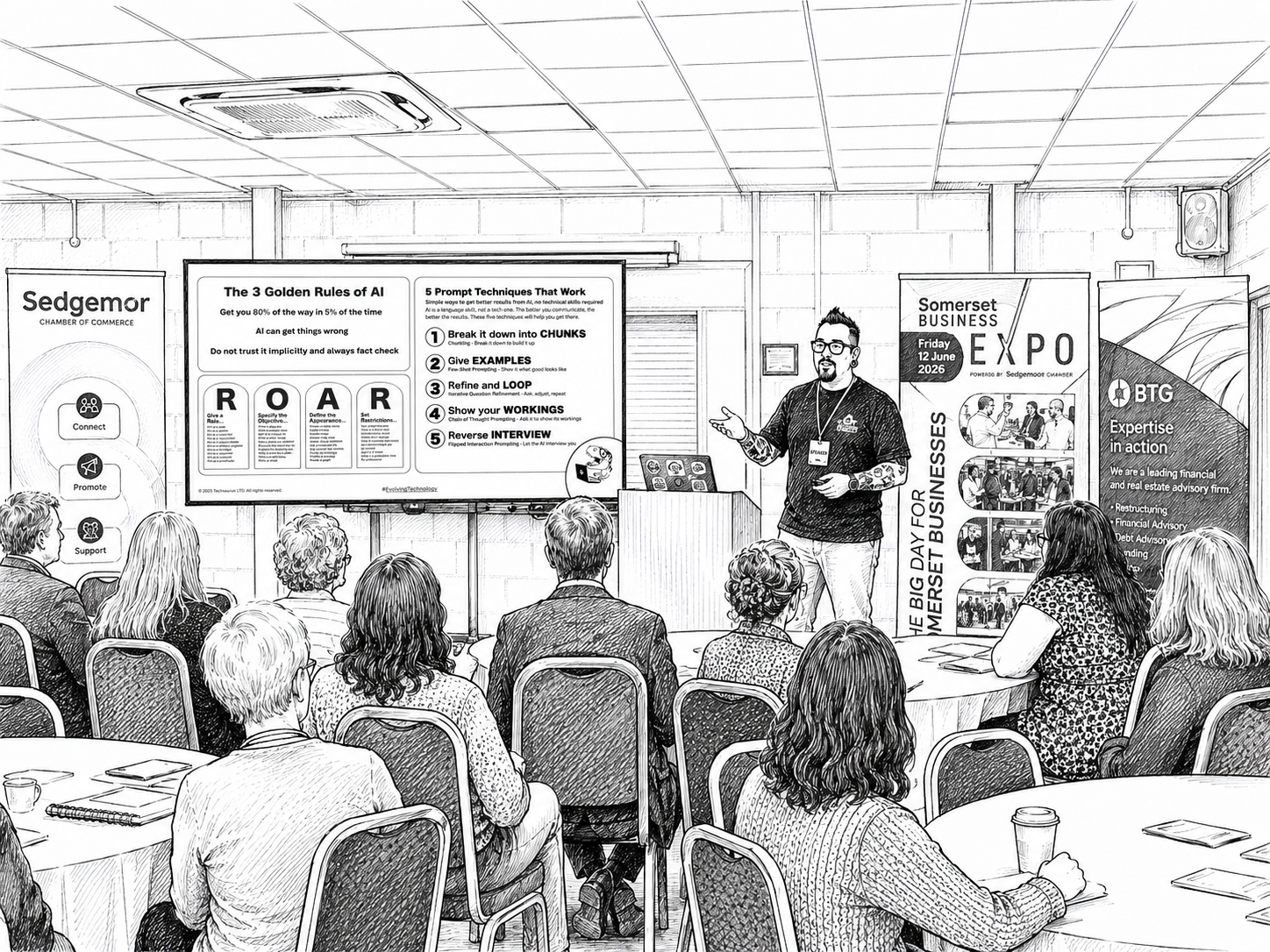
The live demo did what live demos do
I did a live demo during the keynote, which is always a bold life choice when you’re relying on venue Wi-Fi.
The internet had other ideas.
So we did what every person who works with technology eventually learns to do: we adapted, borrowed a hotspot, and carried on.
The demo was about building a skill from a meeting transcript. The aim was to create branded Techosaurus meeting notes from a raw transcript, with sections for attendees, date, summary, decisions, actions, owners, timings, and missing information.
The first output was decent. About 70% there.
And that’s the point people often miss.
You check it. You give it a snag list. You tell it what wasn’t quite right. Page numbers missing. Font off. Spacing wrong. Layout needs a page break. Then you ask how to make sure it gets closer next time, and update the skill accordingly.
That’s how you manage AI well.
The same way you’d manage a person: clear brief, feedback, correction, better process next time.
The danger is letting AI do your thinking
One of the questions from the room was about the negatives of AI.
My answer was mostly about cognitive fitness.
We now live in a world where we can offload thinking. That’s new. Since the calculator, we’ve been able to offload bits of mental work, but generative AI goes much further. It can draft, summarise, plan, write, compare, explain, and suggest.
That can make you better.
It can also make you lazy.
The analogy I used was physical fitness. Generations before us did far more manual work as part of daily life. In the modern world, if you want to be fit, you often have to make a conscious choice to exercise.
The same thing is starting to happen with thinking.
If AI writes every email for you, you may slowly lose the ability to write a good email. If AI coaches you on how to improve your email, you can become better at writing them.
That difference matters.
Ask AI to challenge you. Ask it to quiz you. Ask it to review your work and tell you what could be clearer. Ask it to help you learn the thing, rather than quietly doing all the thinking while you watch.
That’s where the real value is.
Businesses need a joined-up approach
One question near the end was about how businesses should handle AI across a team.
This is where leaders need to pay attention.
If staff are using their own AI accounts for company work, the business has a problem. You wouldn’t ask a new employee to set up their own email address for company use. You’d provide the right tool, with the right protection, and you’d know what happens when they leave.
AI should be treated with the same seriousness.
A joined-up approach means choosing tools properly, training people properly, and sharing good methods across the business.
If one person builds a brilliant skill for meeting notes, risk assessments, proposals, lesson plans, customer follow-ups, or policy drafts, share it. That’s how the whole team gets better.
Buying everyone a licence and wishing them luck is not a strategy.
Somerset businesses have a real opportunity here
What I liked about the Expo was the mix.
Established organisations. Growing businesses. Newer brands trying to get seen. People offering support. People looking for support. People learning, asking, testing, and connecting.
That’s the right environment for AI adoption, because AI is much less scary when people talk about it in practical terms.
How does this help my work?
What should I protect?
Where do I still need human judgement?
What can my team learn together?
Those are the questions that will move businesses forward sensibly.
And the good news is, nobody got an operating manual for this. Everyone is working it out. That means the businesses that stay curious, stay practical, and keep their people involved have a real chance to build confidence before the noise gets even louder.
Exhibit at Somerset Business Expo 2027
Plans for Somerset Business Expo 2027 are already underway.
If you want to put your business in front of Somerset’s business community, meet potential customers, build new relationships, and be part of one of the county’s biggest business events, exhibiting is worth looking at.
The Expo brings together exhibitors, visitors, speakers, sponsors, workshops, and business support in one place. For an established organisation, a growing business, or a newer brand trying to get more visible, it’s a strong room to be in.
Register your interest to be among the first to hear about stand bookings, availability, pricing, and launch updates for Somerset Business Expo 2027 - find out more here - Somerset Business Expo 2027